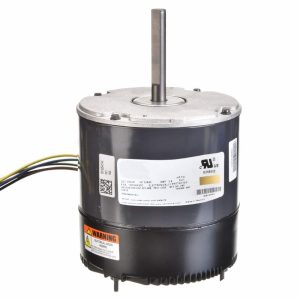
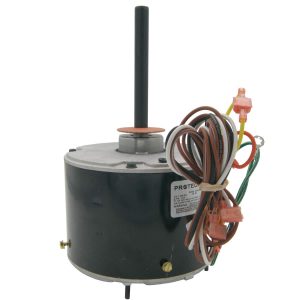
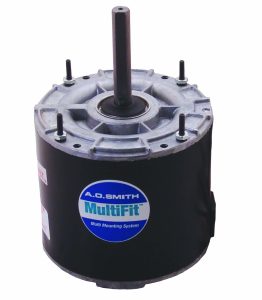
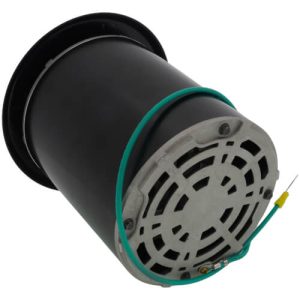
MOT21755 – ECM CONDENSER MOTOR
Shut off the breaker and pull the disconnect at the condenser - that is it, and no screwdriver tricks across the capacitor terminals. Then before the blade goes back on, note how far down the shaft the old hub sat and match it. Blade depth in the shroud is a real airflow spec, not a guess. Set it high and you will chase head pressure all summer. Put the rain shield back on if the unit came with one, and point any weep holes down.
10226 Plano Rd, Suite 104, Dallas TX 75238
Questions? Call or text (214) 340-9421
Mon–Fri 10 am – 7 pm | Sat 10 am – 3 pm
Symptoms of failure
- Outdoor fan will not start, or hums without turning
- Condenser runs hot and trips on high head pressure
- Fan starts only after you push the blade by hand
- Motor cycles on and off on internal overload
- Grinding or rumbling from the top of the condenser
- Blade spins freely but the motor never comes up to speed
Seeing these does not always mean this part is the culprit. Bring the old one in and we will meter it at the counter, free, before you buy.
ECM condenser fan motor carried under the Trane/American Standard MOT- OEM part number series. No manufacturer-published specification sheet was found for this number, so horsepower, RPM, voltage and rotation direction are omitted rather than guessed. Confirm against the motor nameplate before installing.
Specs
- Part typeCondenser fan motor
- Motor technologyECM (electronically commutated)
- OEM number seriesTrane / American Standard MOT-
- Published ratingsNot published by the manufacturer
- Data SourceOTP stock record - not manufacturer-verified
Installing it yourself
- Shut off the breaker to the condenser and pull the disconnect. Verify dead at the contactor with a meter, not just a tester.
- Photograph the existing wiring and the fan blade position on the shaft - blade height sets the airflow.
- Remove the top grille screws, lift the fan deck off, and set it aside without stretching the harness.
- Loosen the blade set screw, pull the blade, then unbolt the old motor from the deck.
- Mount the new motor, reinstall the blade at the same shaft depth you photographed, and tighten the set screw on the flat.
- Land the leads by colour per the nameplate table in the specs, restore power, and confirm the fan ramps rather than snapping to full speed.
Power off at the disconnect first, every time. Not sure partway through? Bring it to the counter and we will walk it with you.
Cross-reference numbers
This part replaces the following OEM and aftermarket numbers:
- MOT12005
- 4TTX6036B1000AA
- 4A6Z0048A1000BA
- D154219P01
Not sure if your number matches? Call (214) 340-9421 or bring the old part in — bench-testing is free.
Fits these models
- 4TTX6036B1000AA
- 4A6Z0048A1000BA
How do I know whether I need CW or CCW rotation?
Read it off the old nameplate and confirm which end it is called from. Rotation is verified from the SHAFT end unless the tag says otherwise. You will see it written CWSE (clockwise, shaft end) or CCWLE (counter-clockwise, lead end), and those two describe the same spin viewed from opposite ends. Get it backwards and the fan pulls air down through the coil instead of out the top. It will run, it will just build head pressure and trip out. Many universal motors reverse by swapping the two rotation leads, but plenty do not, so check before you buy.
Do I have to match horsepower exactly?
Match it, or go up one step at most. A 1/6 to 1/5 or a 1/4 to 1/3 swap is acceptable. A 1/4 to 1/2 is not. Never go down. Then match RPM class, voltage, shaft diameter and length, and the physical depth of the motor body. A taller aftermarket motor sits the blade higher in the shroud and costs you airflow.
Is 1075 versus 1100 RPM a problem?
No. Both are 6-pole, nominal 1200. That 25 RPM is a rating convention, not a spec to worry about. An 825 RPM motor is 8-pole and IS a different motor.
Why do these fail so fast around Dallas?
Because they run 8 or 9 months a year with 100 to 110F air coming off the coil and sun on the cabinet, and bearings and winding insulation both age on heat. A weak run capacitor makes it worse, because the motor draws high amps and cooks. That is why we meter the capacitor before we sell anybody a motor.
- Low Stock
 ProTech
51-106394-03 - CONDENSER MOTOR (1/3HP, 8 POLE, ECM)
SKU · 51-106394-03$520.44View details → - Low StockTrueline
W51-MHCJA1-02 - CONDENSER MOTOR (1/3 - 1/4 - 1/5 HP, 1075 RPM, 10 MFD)
SKU · 19l41$142.69View details → - Low Stock
 Century
9723 - CONDENSER MOTOR (1/4 - 1/6 HP, 1075 RPM, 42Y, 7.5MFD)
SKU · 9723$178.63View details → - Low StockYork
S1-6007531 - CONDENSER MOTOR
SKU · S1-6007531$469.96View details →