
Furnace Limit Switch Cross-Reference & Fitment Guide
Supco SHL and AT universal limits, White-Rodgers fan/limit controls, the OEM numbers they replace, what a limit switch actually does, and the control board fault code every brand uses when one opens.
Read this before you call
This is a free reference tool, here for you to use whether you buy from us or not. Open To Public HVAC Parts is a walk-in counter at 10226 Plano Rd, Suite 104, Dallas, TX 75238. We do not ship, and we cannot cross a limit switch over the phone — too much of the match is physical. Bring the old switch in and we will put it next to the replacement on the counter.
On this page
- What a limit switch actually is
- The three limits people all call “the limit”
- Telling the types apart by sight
- What happens when one opens
- The three things that have to match
- The one substitution we refuse
- Supco SHL501–SHL525 stem limits
- Supco SHL120–SHL250 snap-disc limits
- OEM number to universal cross-reference
- Adjustable limits (AT series)
- Fan/limit controls (5D51)
- Fault codes for an open limit, by brand
- When the limit is not the problem
- Questions we get at the counter
- Sources
What a limit switch actually is
A furnace limit switch is a thermostat. That is the whole device. It is a temperature-operated switch, normally closed, wired in series with the gas valve circuit, and it opens when the air around its sensing element gets hotter than its rating. When it opens, the furnace stops making heat.
It is not electronic. It does not talk to the control board beyond being open or closed. It has no settings on most furnaces, no polarity, and nothing to program. People treat it as a mysterious safety component because it lives inside a furnace, but the thing in your hand is a bimetal disc or a bimetal stem that bends at a set temperature and snaps a contact open.
That is why universal replacements work, and it is why we sell far more universals than OEM part numbers across this counter. If the cut-out temperature is close, it opens the right circuit, and it physically fits, it will do the job the original did.
Everything below is the detail behind those three tests.
The three limits people all call “the limit”
Three different parts get called “the limit switch,” and they are not interchangeable with each other even though they look similar. Goodman’s service literature names them plainly:
Primary limit
Mounted on the partition panel, watching heat exchanger compartment temperature. Normally closed, automatic reset. This is the one that trips on a dirty filter and re-closes by itself.
Auxiliary limit
On or near the circulator blower, watching blower compartment temperature. Normally closed, manual reset. It is there because a failed blower cooks that compartment.
Rollout limit
On the burner/manifold assembly, watching for flame rolling back out of the burner box. Normally closed, manual reset. If this one opens, something is badly wrong.
Source: Goodman GMVM97/GCVM97 Service Manual, p.55. Goodman also puts a boxed warning on the auxiliary: “To avoid possible fire, only reset the auxiliary limit control once. If it should open a second time, a qualified servicer must determine why the auxiliary limit opened before resetting again.”
The pattern is consistent across brands: reset type is assigned by what the switch is protecting. Automatic where the fault is expected to clear on its own, manual where a human needs to look at the furnace before it runs again. Hold on to that — it is the one rule on this page we will not bend.
Telling the types apart by sight
Half of the substitution test is physical, and a table cannot show you a shape. These are photographs of parts on our own shelf. Tap any of them for the full specification.
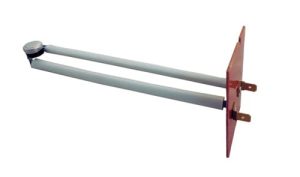 Stem / plenum typeSHL525The element is the long probe. It passes through the panel into the air stream, and insertion length is the dimension that varies across otherwise identical parts.
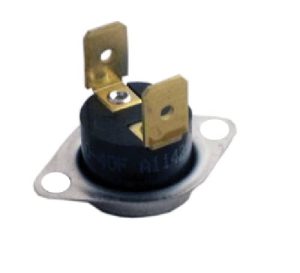 Snap-disc, automatic resetSLS300A round bimetal disc with spade terminals and no button. It opens on rise and re-closes on its own once things cool.
 Manual resetSWT02173Same idea, but note the button. That button is how you tell the two apart — if the old one had one, the new one needs one.
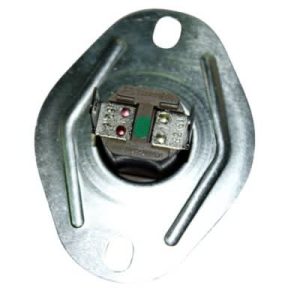 Micro body, large baseHH18HA499An OEM bracket shape. The disc is standard, the base is not, which is why a universal disc often will not bolt straight up.
 Double stack626458RTwo switches stacked in one body, common on electric furnaces and mobile-home units. It replaces as a unit.
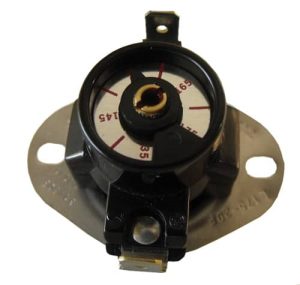 Adjustable discAT014A dial across a 40° range. Useful when no fixed disc covers the temperature you need, or the original is long gone.
 Fan/limit control5D51-90Two switches on one bimetal element in a housing — a fan switch and a limit. Not a plain limit and not interchangeable with one.
 Micro body, large base — manualB1370110Same family as above in a manual-reset version. Body style and reset type are independent of each other.
Body style and reset type are separate questions — the same shape exists in both. Read the L number and check for a button before you match anything.
What happens when one opens
The sequence is close to identical across manufacturers. The gas valve drops immediately, the blower is force-run to pull the leftover heat out of the heat exchanger, and the board waits for the switch to re-close. If it does not re-close fast enough, or if it trips too many times, the board escalates to a lockout.
Nordyne states it in one sentence:
“The main limit control is an automatic reset type. It reacts to abnormally high air temperatures in the heat exchanger area. If the main limit opens, the gas valve is de-energized and the induced draft and main blower motors continue to run. The main limit will automatically reset after the temperature is reduced.”
The published timings are worth knowing, because they explain symptoms people describe at the counter:
| Brand | What the board does when the limit opens | Escalation |
|---|---|---|
| Carrier / Bryant | Blower runs 4 minutes or until the switch re-makes, whichever is longer | Open more than 3 minutes, or 10 successive trips in high heat → limit circuit lockout, auto reset after 3 hours |
| ICP (Heil, Tempstar, Comfortmaker) | Blower runs at intermediate heat airflow for 4 minutes or until it re-makes | Open more than 3 minutes, or 10 successive trips at max heat → lockout, auto reset after 3 hours |
| York / Coleman / Luxaire | Supply air blower and inducer both turn on | Not closed in 5 min → hard lockout, board assumes dead blower. Still open at 15 min → board assumes a rollout opened. Five trips in one heat call → one-hour soft lockout |
| Rheem / Ruud | Blower runs | Open more than 150 seconds → control declares the blower dead. Four dead-blower declarations in one heat call → hard lockout, fault code 61 |
| Lennox | Combustion air inducer OFF, indoor blower ON | Must close within 3 minutes or the unit goes into a 1-hour Watchguard |
| Goodman / Amana | Circulator blower on until the limit closes (7-segment boards also run the induced draft blower) | Continues flashing the limit code while open |
| Nordyne / Nortek | Main blower and induced draft motor both run | Clears when the limit circuit closes |
Lennox is the odd one out — it shuts the inducer off where everyone else runs it. Worth knowing before you diagnose a Lennox by ear.
Two symptoms fall straight out of that table. “The blower runs forever and there is no heat” is the limit circuit open, on almost any brand. And “it heats for a while, quits, then comes back an hour later” is an automatic-reset primary limit tripping and re-closing, which is a signal about airflow, not a signal that the switch is bad.
The three things that have to match
This is the whole substitution test, in the order we check it at the counter.
1. The cut-out temperature is close
The number stamped on the switch is the cut-out, written as an L number — L160 opens at 160°F. It is set at the factory and on most limits cannot be adjusted.
Go higher than the original and you have raised the ceiling the furnace was certified at. Go lower and you get nuisance trips on a furnace that is running perfectly well. Close is what you want; exact is better when it exists.
2. It opens the right circuit
Three parts to this, and all three are pass/fail:
Open on rise, not close on rise. A limit opens as it heats. A fan control closes as it heats. They sit next to each other in the same catalogs and look alike. Fit a fan control in a limit position and the gas valve circuit is open when cold and closes as the furnace overheats — the exact inverse of a safety.
The right reset type. See the next section.
Enough electrical rating. A limit carrying a 24-volt signal to a board is a different duty from one switching a line-voltage blower. Match or exceed.
3. It fits
Stem length is the most-missed dimension. In one Supco series the same temperature exists at 1.87″, 3.12″ and 7″. Too short and the element sits in the wrong air stream and trips late; too long and it fouls the heat exchanger.
Mounting footprint. Supco publishes three different board sizes inside one series — SHL501 and SHL513 are otherwise identical parts that differ only in board height, 2.8″ against 2.94″.
Terminals and gasket. Bring the old one so we can compare spade sizes. ICP explicitly lists “improper limit switch or no limit gasket” as a cause of limit circuit faults.
The differential is the fourth thing, and it matters less than the other three but it is worth understanding. Every automatic-reset limit has a cut-out and a cut-in, and the gap between them is the differential. An L170-40 opens at 170°F and re-closes at 130°F. An L170-20 opens at the same 170°F but re-closes at 150°F. Same cut-out, different recovery behaviour. If a furnace short-cycles after a limit change, a differential mismatch is a likely reason.
The one substitution we refuse
We will not sell you an automatic-reset limit to replace a manual-reset one, or the reverse — no matter how well the temperature, stem length and mount line up.
Reset type is not a preference. The furnace manufacturer assigns it by function, and swapping it does two separate kinds of damage.
Auto fitted where manual belongs is the dangerous direction. A manual-reset limit sits in the positions where the manufacturer requires a human to inspect the appliance before it runs again — rollout, blower compartment, blocked vent. Put an automatic part there and the condition that was supposed to force a service call now silently clears itself and the furnace re-fires. Flame rolling out of the burner box becomes a thing that happens quietly, over and over, with nobody ever seeing it.
There is a second consequence that is less obvious. Several control boards identify which safety opened by how long it stays open. York, in its own words: “If, after fifteen minutes, the main limit still has not closed, the control will assume that a manual-reset rollout switch has opened and will begin to flash the 5 Red Flash error code.” Substitute an auto-reset part and the board never reaches that conclusion. The rollout code is never reported and the next technician is sent down the wrong path.
Manual fitted where auto belongs is the nuisance direction, and it is still wrong. The primary limit is designed to open and re-close on its own; that is why the manufacturer publishes a cut-in temperature for it. Put a manual-reset part in that position and every dirty-filter trip becomes a no-heat call. Worse, the boards read a limit that cannot re-close as a dead blower — Rheem declares exactly that after 150 seconds — and the next person replaces a perfectly good blower motor.
Every manufacturer prints the same boilerplate on safety controls: replace only with identical OEM parts, and never bypass or jumper a safety switch. We stock and sell universals daily and they work. Reset type is where the boilerplate and the counter agree.
Supco SHL501–SHL525 stem limits
These are the universal stem-type limits that replace most board-mounted OEM limits on gas furnaces. Supco catalogs them as “Gas Furnace Limits and Plenum Thermostats,” style 36TX01B, 350°F maximum ambient. All are SPST and open on rise. Supco publishes a cut-in temperature and a differential for every one, which is what makes them automatic reset — Supco’s manual-reset limits are the separate SHM series.
| Part | Description | Opens | Closes | Diff. | Board W | Board H | Insertion |
|---|---|---|---|---|---|---|---|
| SHL501 | L170-40 SPST | 170° | 130° | 40° | 1.88″ | 2.8″ | 3.12″ |
| SHL502 | L180-30 SPST | 180° | 150° | 30° | 1.88″ | 2.8″ | 3.12″ |
| SHL503 | L190-40 SPST | 190° | 150° | 40° | 1.88″ | 2.8″ | 3.12″ |
| SHL504 | L240-40 SPST | 240° | 200° | 40° | 1.88″ | 2.8″ | 3.12″ |
| SHL505 | L140-40 SPST | 140° | 100° | 40° | 1.88″ | 2.8″ | 1.87″ |
| SHL506 | L170-40 SPST | 170° | 130° | 40° | 1.88″ | 2.8″ | 1.87″ |
| SHL507 | L140-30 SPST | 140° | 110° | 30° | 1.88″ | 2.8″ | 3.12″ |
| SHL508 | L190-20 SPST | 190° | 170° | 20° | 1.88″ | 2.8″ | 3.12″ |
| SHL509 | L240-30 SPST | 240° | 210° | 30° | 1.88″ | 2.8″ | 3.12″ |
| SHL510 | L150-20 SPST | 150° | 130° | 20° | 1.625″ | 1.44″ | 3.12″ |
| SHL511 | L160-20 SPST | 160° | 140° | 20° | 1.625″ | 1.44″ | 3.12″ |
| SHL512 | L170-20 SPST | 170° | 150° | 20° | 1.625″ | 1.44″ | 3.12″ |
| SHL513 | L170-40 SPST | 170° | 130° | 40° | 1.88″ | 2.94″ | 3.12″ |
| SHL514 | L180-40 SPST | 180° | 140° | 40° | 1.88″ | 2.94″ | 3.12″ |
| SHL515 | L200-40 SPST | 200° | 160° | 40° | 1.88″ | 2.94″ | 3.12″ |
| SHL516 | L210-40 SPST | 210° | 170° | 40° | 1.88″ | 2.94″ | 3.12″ |
| SHL517 | L220-50 SPST | 220° | 170° | 50° | 1.88″ | 2.94″ | 3.12″ |
| SHL518 | L250-40 SPST | 250° | 210° | 40° | 1.88″ | 2.94″ | 3.12″ |
| SHL519 | L155-30 SPST | 155° | 125° | 30° | 1.88″ | 2.8″ | 7.12″ |
| SHL520 | L100-20 SPST | 100° | 80° | 20° | 1.88″ | 2.8″ | 7″ |
| SHL521 | L200-20 SPST | 200° | 180° | 20° | 1.88″ | 2.8″ | 7″ |
| SHL522 | L160-20 SPST | 160° | 140° | 20° | 1.88″ | 2.8″ | 7″ |
| SHL523 | L130-20 SPST | 130° | 110° | 20° | 1.88″ | 2.8″ | 7″ |
| SHL524 | L170-20 SPST | 170° | 150° | 20° | 1.88″ | 2.8″ | 7″ |
| SHL525 | L180-20 SPST | 180° | 160° | 20° | 1.88″ | 2.8″ | 7″ |
Read this table for the traps, not just the temperature
SHL501 and SHL506 are both L170-40. Different insertion lengths — 3.12″ against 1.87″.
SHL501 and SHL513 are both L170-40 at 3.12″. Different board heights — 2.8″ against 2.94″.
SHL512 and SHL524 are both L170-20. Different insertion lengths — 3.12″ against 7″.
Three parts, same L number, and only one of them bolts into your furnace. This is why we cannot do it over the phone.
Electrical rating for the whole SHL5xx family is Supco’s 36T class: 120 VAC 15 A resistive, 3 A motor FLA, 12 A LRA, 125 VA pilot duty; 240 VAC 10 A resistive, 1.5 A FLA, 6 A LRA, 125 VA pilot duty. Range −40°F to 350°F.
What Supco does not publish for this family: mounting hole spacing or hole diameter (only the board footprint), terminal type and size, and the words “automatic reset” (the cut-in temperature and differential are published instead, which tells you the same thing). We are not going to invent those numbers. Bring the switch in and we will compare it physically.
Supco SHL120–SHL250 snap-disc limits
A different family under the same SHL prefix, and the source of a lot of mis-ordering. These are snap-disc limit controls, style 60T11, supplied with an adapter flange plate. They are not stem type and they are not interchangeable with the SHL5xx above.
| Part | Function | Cut out | Cut in | Diff. |
|---|---|---|---|---|
| SHL120 | Limit – open on rise | 120° | 110° | 10° |
| SHL140 | Limit – open on rise | 140° | 100° | 40° |
| SHL150 | Limit – open on rise | 150° | 110° | 40° |
| SHL160 | Limit – open on rise | 160° | 120° | 40° |
| SHL170 | Limit – open on rise | 170° | 130° | 40° |
| SHL180 | Limit – open on rise | 180° | 140° | 40° |
| SHL190 | Limit – open on rise | 190° | 150° | 40° |
| SHL200 | Limit – open on rise | 200° | 160° | 40° |
| SHL230 | Limit – open on rise | 230° | 190° | 40° |
| SHL250 | Limit – open on rise | 250° | 210° | 40° |
Rating class here is 60T, not 36T — a heavier switch. 120 VAC 25 A resistive, 14 A FLA, 72 A LRA; 240 VAC 25 A resistive, 10 A FLA, 60 A LRA; 125 VA pilot duty. Supco’s matching manual-reset discs are the SHM series (SHM125 through SHM350, style 60T15), and its close-on-rise fan controls are the SHF series (style 60T12). Three families, three jobs, one shelf — read the letter after SH.
SHL210, SHL300 and SHL325 appear in an older Supco catalog but not in the current full-line book. If you need one of those, ask — current availability needs checking rather than assuming.
OEM number to universal cross-reference
These crosses are Supco’s own, published in its full-line catalog. Where a manufacturer has not published a cross, we have left it out rather than guessing.
| Universal | Rating | Replaces — Carrier / Bryant / BDP / Day & Night / Payne | Replaces — other brands |
|---|---|---|---|
| SHL508 | L190-20 | HH12ZB190, HH12ZA193, HH12ZA189, P331-2005 | Goodman / Amana / Janitrol B1370913; Trane SWT1260 |
| SHL509 | L240-30 | HH12ZB240, HH12ZA240, HH12ZA252, P331-2217 | Goodman B1370903 |
| SHL513 | L170-40 | — | Lennox / Air-Ease / Armstrong / Concord / Magic Chef 37H73 |
| SHL514 | L180-40 | HH12ZB180 | Lennox 49L03; York 025-29031-711 |
| SHL515 | L200-40 | HH12ZB200, HH12ZA199, HH12ZA201 | York 025-29041-006 |
| SHL516 | L210-40 | HH12ZB210 | Trane SWT1263 |
| SHL517 | L220-50 | HH12ZB220, HH12ZA219, HH12ZA223, 48NHT042, 620BE | Trane SWT1273 |
| SHL518 | L250-40 | HH12ZB250, HH12ZA251, P331-2208 | Goodman B1370012S; Trane SWT1261, SWT1272 |
| SHL522 | L160-20 | — | Goodman B1370908S; Rheem / Ruud / Weather King 47-21711-07 |
| SHL525 | L180-20 | — | Rheem / Ruud / Weather King 47-21711-11 |
If your OEM number is not on this list, that does not mean nothing replaces it. It means Supco has not published a cross for it. The three tests still apply — read the L number off the old switch, note whether it is auto or manual reset, measure the stem, and we will match it from the tables above.
Adjustable limits (AT series)
Supco’s AT series are dial-adjustable open-on-rise thermostats with a 40° adjustable range and quarter-inch quick-connect terminals. They are useful when you need a temperature that no fixed disc covers, or on equipment where the original is long gone.
| Part | Adjustable range | Differential |
|---|---|---|
| AT012 | 135–175°F | 20° |
| AT013 | 175–215°F | 40° |
| AT014 | 210–250°F | 40° |
| AT015 | 250–290°F | 40° |
Supco publishes the range, the differential and the 60T electrical rating for these, and nothing else — no stem length, no mount pattern, no pole configuration. The disc diameter and “SPST” descriptor you will find on retail listings come from distributors, not from Supco, so we do not print them here.
Fan/limit controls (5D51)
A fan/limit control is two switches on one bimetal element in one housing: a close-on-rise fan switch that starts and stops the blower, plus an open-on-rise limit switch that is the safety. White-Rodgers describes the 5D51 as regulating “fan or blower operation” while acting “as high limit safety control.”
These turn up on older furnaces and on any unit without a board doing the blower timing. On a modern board-controlled furnace the board handles the blower and only a plain limit remains — which is why a 5D51 will not substitute for an SHL, or the reverse.
| Part | Element length | Fan section | Limit section |
|---|---|---|---|
| 5D51-35 | 5″ | 50–265°F, close on rise, adjustable differential, 15°F minimum | 100–300°F, open on rise, fixed 25°F differential |
| 5D51-90 | 8″ | same | same |
| 5D51-78 | 11″ | same | same |
The three models differ only in element length. White-Rodgers lays the fan and limit rows across the model rows in its catalog, which reads as though the −35 is a fan control and the −90 is a limit control. It is not. All three are both.
Fan on and fan off are set independently with separate pointers, so the fan differential is whatever you set it to, 15°F minimum. The limit has one pointer — the cut-out. Its cut-in is fixed 25°F below wherever you set it. You cannot adjust the limit differential.
White-Rodgers’ own instruction: “The limit pointer should never be set any higher than the setting recommended by the furnace manufacturer.”
Retail listings for the 5D51-35 give insertion lengths of 0.5″, 4-3/8″ and 5″ depending on where you look. White-Rodgers publishes 5″ element length. We use the manufacturer’s figure.
Fault codes for an open limit, by brand
Every brand has shipped several generations of control board and the code changes between them. There is no such thing as “the Goodman limit code.” Each entry below is tied to a specific board generation, because publishing a brand-level code without that is how a parts page gets a reputation for being wrong.
Two brands do not use a simple flash count and are routinely miscounted:
Carrier, Bryant and ICP use short flashes for the first digit and long flashes for the second. Carrier’s code 33 is three short flashes then three long — not thirty-three of anything.
Lennox does not use a count at all on its conventional integrated controls. You read the combined state of two LEDs. Any site giving you “Lennox limit = N flashes” for that generation is wrong.
| Brand | Board generation | Code | Manufacturer’s wording |
|---|---|---|---|
| Goodman / Amana | Single LED flash | 4 flashes | “Open Primary or Auxiliary Limit” / “Primary or auxiliary limit circuit is open” |
| Goodman / Amana | Seven-segment | EE3 | “Open High Limit Switch” / “Primary limit circuit is open” |
| Carrier / Bryant | Amber, short + long | 33 | “Limit Circuit Fault” |
| Carrier / Bryant | Amber, short + long | 13 | “Limit Circuit Lockout” (auto reset after 3 hours) |
| Trane / American Standard | Seven-segment | e04 | “Open Limit (Main Thermal, Rollout Switch, or Reverse Airflow Switch)” |
| Trane / American Standard | Red LED flash | 5 flashes | “Open Limit or Rollout Switch” |
| Rheem / Ruud | Seven-segment | 22 | “Main limit open” |
| Rheem / Ruud | Bluetooth / communicating | 22, A022_F, T022_F | “Main Limit Switch Open” |
| Lennox | Dual LED state | LED 1 slow flash + LED 2 on | “Primary or secondary limit switch open. Limit must close within 3 minutes or unit goes into 1 hour Watchguard.” |
| York / Coleman / Luxaire | Red LED flash | 4 red flashes | “The main limit switch has opened its normally closed contacts” |
| Nordyne / Nortek | Red LED flash | 1 flash | “Limit Circuit open” |
| ICP (Heil / Tempstar / Comfortmaker) | Amber, short + long | 4 | “Limit Circuit Fault” |
| ICP | Amber, short + long | 7 | “Limit Circuit Lockout” (auto reset after 3 hours) |
Three traps in that table
Trane 4 flashes is not the limit. A lot of sites say it is. Trane’s own Service Facts assigns 4 flashes to an inducer or pressure switch error and 5 flashes to an open limit or rollout.
York separates the escalation. 4 red flashes is the limit opening. 11 red flashes means it stayed open past five minutes, which York reads as a failed blower motor or blower wheel. 5 red flashes means it stayed open past fifteen minutes, which York reads as a rollout. Three different codes, one open circuit, and they tell you where to look.
Nordyne does not remember. Its own manual: “The light must be observed before the bottom door is removed since the board does not store the fault condition in its memory.” Read the code before you pull the door.
York’s four-flash code on some models also covers a defective temperature sensor and an open 24-volt fuse, not the limit alone. Lennox’s communicating iComfort systems use a separate numbered alert scheme that we have not verified a limit code from, so we are not printing one. And a limit code always means the circuit is open — not that the switch has failed. Check the wiring and the connectors before you buy anything.
When the limit is not the problem
This is the part worth reading twice. A limit switch that opens is usually doing its job correctly, and the fault is upstream of it. Every manufacturer’s own troubleshooting text says the same thing in the same order.
Goodman lists the probable causes of its four-flash code as “low conditioned air flow due to dirty filter or resistance in duct work, faulty limit, faulty blower, or blower speed set to low.” Note where “faulty limit” sits in that list — third. York’s list is “a dirty filter, improperly sized duct system, incorrect blower speed setting, incorrect firing rate, loose limit switch wiring or faulty blower motor.” ICP adds “loose blower wheel” and “improper limit switch or no limit gasket.”
In plain terms, before you replace the switch:
The filter. The single most common cause. A restricted filter starves the heat exchanger of airflow and the discharge temperature climbs until the limit does exactly what it was designed to do.
Closed or blocked registers and returns. Same effect as a dirty filter. Furniture over a return counts.
The blower. A failing motor, a wheel packed with dust, or a wheel loose on the shaft all move less air. If the limit opens and never re-closes, the boards will read that as a dead blower — and they are usually right.
Blower speed set too low after a previous repair, or a firing rate set too high.
The wiring and the connectors. A limit code says the circuit is open. A heat-damaged spade at the switch reads open with a perfectly good switch on the other side of it.
The wrong switch, fitted last time. ICP names it directly. A limit with too low a cut-out, or one missing its gasket, nuisance-trips on a furnace that is running fine.
If you are on your second or third limit switch in as many seasons, the switch is not the problem. Something is making that furnace run hotter than it was built to run, and the limit is the smoke alarm, not the fire.
Questions we get at the counter
Can I just jumper the limit to get heat tonight?
No. It is the device that stops a furnace overheating, and every manufacturer prints the same warning: do not bypass, jumper or remove a safety switch. If it is tripping, something is wrong with the airflow and the furnace is telling you so.
The old one has no markings left. What do I do?
Bring it in with the furnace model number. The model number gets us to the manufacturer’s parts list, and the physical part gets us the stem length, the footprint and the terminals.
Can I go up a few degrees so it stops tripping?
No. Raising the cut-out raises the temperature ceiling the furnace was certified with, and the reason it is tripping does not go away — you have just removed the thing that was telling you about it.
Is a universal as good as the OEM part?
For a plain limit, yes, and that is what we sell most of. It is a temperature-operated switch. Match the cut-out, match the switch action and reset type, make it fit, and it does the same job. Manufacturers print “identical OEM replacement only” on every safety control; we sell universals across this counter every week and they work.
Auto reset or manual reset — how do I tell?
A manual-reset limit has a button on it. An automatic one does not. Whichever came out is what goes back in.
Do you test limit switches?
We will check continuity on the counter, which tells you whether it is open or closed cold. That is not a full test — a limit is a temperature device and checking its actual trip point needs an oven, not a meter. What we are better at is making sure the replacement is the right one.
Sources
Every specification and every fault code on this page is copied from manufacturer literature. Nothing here is inferred, and where a manufacturer publishes nothing we have said so rather than filling the gap.
- Supco Full Line HVACR Product Catalog — SHL5xx, SHL120–250, SHM, SHF and AT series tables, electrical rating classes, and the OEM cross-reference
- White-Rodgers Warm Air Controls catalog and 5D51 installation instructions — fan/limit specifications and setting procedure
- Goodman GMES96 service instructions and GMVM97/GCVM97 service manual — limit definitions, flash and seven-segment codes, sequence of operation
- Carrier troubleshooting guides 58-06T and TG-GFC80-02 — status codes 33 and 13
- Trane S9V2B Installer’s Guide — seven-segment code e04; Trane Service Facts for the flash-code generation
- Rheem/Ruud R802TA and R802V installation instructions — fault codes, dead-blower logic, safety control warnings
- Lennox ML180UH installation instructions — integrated control diagnostic codes
- York TM9V and YP8C installation manuals — red flash codes and the escalation ladder
- Nordyne G6RA/G6RK service manual — status light table and sequence of operation
- ICP variable speed modulating troubleshooting guide — status codes 4 and 7
Bring the old switch to the counter.
Open To Public HVAC Parts, 10226 Plano Rd, Suite 104, Dallas, TX 75238. Monday to Friday 10–7, Saturday 10–3. No account, no appointment, no minimums. We will put your old switch next to the replacement and check the temperature, the action, the stem and the footprint before you pay for anything.
We stock the Supco SHL and SLS ranges, adjustable AT limits, White-Rodgers fan/limit controls, and OEM limits for Carrier, ICP, Rheem, Goodman, York and Trane.
Related reference charts
- Furnace control board cross-reference — the board reading you the limit code
- Hot surface ignitor cross-reference
- Gas valve cross-reference
- Blower wheel cross-reference — when the limit is tripping because of airflow
- Furnace short cycling
- Tell us what it is doing and we will tell you what to bring
Not sure what system you have?
Type the model number off your data plate into our free lookup and we’ll read the nominal tonnage, the brand family and roughly how old it is.
Look Up My Model Number