
AC Piston & Flowrator Orifice Size Chart
Flowrator piston sizes for R-410A and R-22 across Lennox, Goodman, Rheem, Allstyle and First Co — and why the tonnage on the nameplate is not the specification.
READ THIS BEFORE YOU CALL
This chart is a free reference tool, here for you to use on your own. Open To Public HVAC Parts is a walk-in parts counter in Dallas, Texas.
- In-store sales only — no shipping, no online orders.
- We cannot look up or cross parts over the phone or by email.
If you are local, bring the old piston and your equipment model numbers to 10226 Plano Rd, Suite 104, Dallas TX and we will work through it with you at the counter.
A piston — Goodman calls it a Flowrator, Carrier calls it an AccuRater, Lennox calls it an RFC orifice — is a brass plug with a precisely drilled hole that meters refrigerant into the evaporator. The number stamped on it is the bore in thousandths of an inch. A .068 has a 0.068″ hole.
Almost everybody arrives here looking for one thing: what size piston does a 3 ton system take? The honest answer is that the question has no single answer, and this page exists to show you why and then get you to the right number anyway.
The 30-second version — how to find YOUR size
- Work out which style you have first. Flowrator, Carrier AccuRater or Nordyne restrictor — they are not interchangeable, and we only stock the first. Thirty seconds on that here.
- On a Goodman or Amana, look up the outdoor model in the piston chart, then check whether your specific indoor coil is one of the listed exceptions.
- On a Rheem or Ruud, read the coil model number. The piston size is two digits inside it — an RCBA-2457T carries a .057.
- On a Lennox, check the outdoor unit bulletin for the RFC orifice size. Do not read the bore off the part number — Lennox indexes theirs.
- On a Carrier or Bryant, read the outdoor rating plate. They have printed it on every split system since January 1989. Most ICP brands print it too.
- Pull the old one and read it. It is stamped. But verify it against the chart — the piston in the coil may already be somebody else’s mistake.
- Only if none of that is available, fall back to a generic tonnage chart. That is a last resort, not the method.
On this page
- Which style is it? (and which we stock)
- Why “3 ton = .074” is wrong
- Where to find your number, by brand
- Generic tonnage charts (last resort)
- The Flowrator pistons we stock
- R-410A vs R-22 sizing
- Symptoms of a wrong piston
- Piston vs TXV, and converting
- How to change one
- Charging: superheat, not subcooling
- The mistakes that cost the most
- Questions we get at the counter
Which style is it? — and which one we stock
Before any chart matters, work out which family of metering device you are holding. The bore is only half the part. The body it seats in, how it is captured and how it seals differ between families, and they are not interchangeable even when the hole is the same size.
What we carry
We stock the Flowrator style — the two-piece screw-together brass body with a loose sliding piston and a flat white Teflon seal. That is what is in most Lennox, Goodman, Amana, Rheem, Ruud, Allstyle and First Co equipment.
We do not stock the restrictor style used by Carrier and Bryant, or the one used by Nortek and Nordyne (Miller, Intertherm, Maytag, Frigidaire, Gibson, Westinghouse, Tappan, Broan). Those are different assemblies, and a Flowrator piston will not work in either.
← Swipe the table sideways to see every column →
| Flowrator style we stock this | Carrier / Bryant AccuRater | Nortek / Nordyne restrictor | |
|---|---|---|---|
| Brands | Lennox, Armstrong, Ducane, Goodman, Amana, Rheem, Ruud, ADP, Allstyle, First Co | Carrier, Bryant, and Carrier-family brands | Nordyne, Miller, Intertherm, Maytag, Frigidaire, Gibson, Westinghouse, Tappan, Broan |
| What the maker calls it | Flowrator, Flowrater, Florator, Flowcheck, Flow Check, RFC orifice, restrictor (Lennox usage) | AccuRater | Restrictor orifice |
| How the piston is captured | Between two brass body halves that screw together. Goodman uses a 13/16″ nut. | Behind a separate pull-out retainer that also forms the bypass stop and the flare sealing face | Between two body halves that separate, pulled out with a wire hook |
| How it seals | Flat white Teflon ring, replaceable | Elastomeric O-ring on the retainer, plus a brass flare seat | No Teflon ring called out in their literature — brass to brass |
| Liquid line connection | Chatleff-style thread | 3/8″ male flare | Sweat |
| Torque | 10–20 ft-lb, or 1/6 turn past hand tight | Per Carrier literature | 10–12 ft-lb |
| Part families | Goodman B1789xxx · Lennox 100484-xx · Rheem 61-25414-xx · Chatleff 38-3103-0xx · Allstyle RP311xx · First Co CP81-xx | EA52PH0xx, EA52PJ0xx, EA52PT0xx. Retainer and O-ring 99CC409892 | 664xxxR — last three digits are the bore. Distributor body 663580R |
| Interchangeable within the family? | Yes. Same piston across Lennox, Allstyle, First Co, Goodman and Rheem — only the box changes. Match the bore, not the brand. | No. Different capture, different seal, different line connection. | No. |
Telling them apart from the old part in your hand
Inside the Flowrator family, it is one part
A Chatleff-style Flowrator piston is a Chatleff-style Flowrator piston. We have physically done these swaps across Lennox, Allstyle, First Co, Goodman and Rheem — they are the same part. The brand on the air handler changes the part number on the box and nothing about the brass in your hand.
That is worth saying plainly because no manufacturer publishes it. Goodman does not cross-reference to Lennox, Rheem does not cross-reference to Allstyle, First Co publishes nothing at all, and Danfoss treats the dimensions as proprietary. The only published crumb is that Chatleff’s own 38-3103 pistons are sold as replacements for both Lennox 100484 and Rheem 61-22614. Everything past that, the trade knows from doing it.
So if you are looking for a Lennox RFC orifice, a Rheem Flowcheck, an Allstyle florator or a First Co CP81 in a bore we stock, the piston on our shelf is your part.
What a Chatleff-style assembly actually looks like
Three parts make up the joint, and seeing them apart is the quickest way to tell which family you are holding. These are photographs of stock on our own shelf.
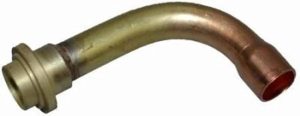 The fittingB1796630The brass body half, with the copper stub that sweats onto the line. This and the nut are the two halves that screw together.
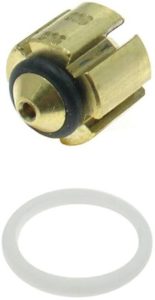 The pistonB1789868It sits loose inside and slides. The bore is the whole specification and you cannot judge it by eye — go by the number, not the look.
 The nut and Teflon sealB1796632That flat white Teflon seal is the giveaway for this family. A Carrier AccuRater seals with an elastomeric O-ring behind a pull-out retainer instead.
We stock the Flowrator / Chatleff style only — Lennox, Goodman, Amana, Rheem, Ruud, Allstyle and First Co. We do not stock the Carrier / Bryant AccuRater or the Nordyne restrictor, so if your old part has a pull-out retainer with a rubber O-ring, or sweat connections and no Teflon seal, it is not one of ours.
Why “3 ton = .074” is wrong
The piston is specified by the AHRI-matched combination — the specific outdoor unit paired with the specific indoor coil — not by tonnage. Manufacturers are blunt about this in their own literature.
In their own words
ICP titled its R-410A piston bulletin “It’s the OUTDOOR Unit that Determines What Size to Use Indoors,” and warns: do not assume a same-size matched fan coil has the correct piston, because air conditioners often need different sizes than heat pumps, and higher-SEER models often differ from 13 SEER.
Goodman prints this on every page of its piston chart: no warranty claim will be honored for mix-matched systems that fail to adhere to the specified piston size.
Rheem: it is imperative that the proper piston size be used depending on indoor coil, outdoor unit combination and application.
The counterexample: one brand, one tonnage, five answers
Carrier’s own piston guide, 3-ton (036) outdoor units. We do not stock Carrier pistons — this is here because Carrier publishes the clearest proof that tonnage does not determine the answer, and the same principle governs the Flowrator brands we do stock:
← Swipe the table sideways to see every column →
| Outdoor model | Piston | Outdoor model | Piston |
|---|---|---|---|
| 38CK-036-520 | 65 | 38CK-036-320 | 73 |
| 38CK-036-500 | 67 | 38BR-036-300 | 76 |
| 38CK-036-300 | 70 | 38CK-036-700 | 76 |
| 38BR-036-310 | 73 | 38CM-036-300 | 76 |
Goodman, 3-ton R-410A. Six answers, and one of them is not a piston at all:
← Swipe the table sideways to see every column →
| Outdoor model | Indoor coil | Piston | Part number |
|---|---|---|---|
| GSX130361(B,E) | All AHRI matches | .070 | B1789870 |
| GSX130361D | All AHRI matches | .067 | B1789867 |
| GSX130362A | A36-00-2R | .065 | B1789865 |
| GSX140361A / GSX140361K | All AHRI matches | .068 | B1789868 |
| GSX160361F | ASX160361F | .072 | B1789872 |
| GSX160361F | ASX160361** | TXV only (TXV-42) | — |
The same outdoor unit, different coil, different piston
This is the part that catches people. Nothing changes outside — only the coil:
← Swipe the table sideways to see every column →
| Outdoor model | Indoor unit | Piston |
|---|---|---|
| GSX140301K (2.5T R-410A) | AWUF31 & AWUF32 | .061 |
| GSX140301K (2.5T R-410A) | All other AHRI matches | .065 |
| GSZ130361A (3T R-410A HP) | ARUF36C | .071 |
| GSZ130361A (3T R-410A HP) | AR*F3636 | .070 |
| GSZ130361A (3T R-410A HP) | All other AHRI matches | .068 |
| GSZ130601A (5T R-410A HP) | CHPF4860D6D | .086 |
| GSZ130601A (5T R-410A HP) | All other AHRI matches | .088 |
Where to find your number, by brand
← Swipe the table sideways to see every column →
| Brand | Style | Where the number lives | Published chart? |
|---|---|---|---|
| Goodman / Amana / Daikin | Flowrator | Piston Kit Chart, by outdoor model with per-coil exceptions. Correct piston is usually supplied with the outdoor unit. | Yes — PKCG-4001 series, fully public |
| Lennox / Armstrong / Ducane | Flowrator | In the outdoor unit bulletin spec table, listed as “RFC metering orifice size furnished.” Many Lennox coils ship with a factory TXV instead and have no piston at all. | Partial — per outdoor line, no master chart |
| Rheem / Ruud | Flowrator | Encoded in the indoor coil model number — the two underscored digits. RCBA-2457T = .057. | No consolidated chart. Read the model number. |
| Allstyle Coil (Houston TX) | Flowrator | Ships bi-directional as standard. Allstyle publishes a straight tonnage chart, below. | Yes — in their coil installation instructions |
| First Co (Dallas TX) | Flowrator | Nomenclature code P means piston, V means TXV. Pistons are the CP81-xx family, where xx is the bore. | No public chart — they direct you to the factory |
| Carrier / Bryant | AccuRater — not stocked | Printed on the outdoor unit rating plate on every split system since January 1989. The correct cooling piston also ships with the outdoor unit. | Yes — the Piston Guide for Residential Split-Systems |
| ICP (Heil, Tempstar, Comfortmaker, Arcoaire) | Carrier family | Printed on the outdoor rating plate on some lines; the bulletin says explicitly which lines do not print it. | Yes — Product Information Bulletin PIB10-18 |
| Nortek / Nordyne | Restrictor — not stocked | On split-system outdoor units the restrictor is in the swivel nut of the liquid service valve, not in a coil distributor. Part numbers are 664xxxR and the digits are the bore. | Parts lists only |
| Trane / American Standard | Own design | Predominantly TXV systems. We could not find a public consolidated piston chart for mainline Trane coils. | Not that we could locate |
Generic tonnage charts — the last resort
If the rating plate is gone, the coil model is unreadable and you cannot find the OEM chart, these are the published fallback tables. We are showing you three, from three manufacturers, because they disagree with each other. That disagreement is the honest reason not to treat any one of them as the specification.
ADP’s own instructions put it best: size the piston to the outdoor unit manufacturer’s recommendation, and only if the manufacturer does not give one, use the generic chart.
← Swipe the table sideways to see every column →
| Nominal tons | ADP R-22 | ADP R-410A | Trane/Oxbox R-22 | Trane/Oxbox R-410A | Lennox 13ACX R-410A |
|---|---|---|---|---|---|
| 1 ton | .041 | .041 | — | — | — |
| 1.5 ton | .053 | .049 | .052 | .052 | .051 |
| 2 ton | .059 | .053 | .058 | .058 | .057 |
| 2.5 ton | .067 | .059 | .065 | .063 | .065 |
| 3 ton | .073 | .067 | .072 | .070 | .072 |
| 3.5 ton | .080 | .073 | .078 | .075 | .076 |
| 4 ton | .084 | .076 | .088 | .083 | .082 |
| 5 ton | .093 | .093 | .096 | .090 | .090 |
Allstyle Coil — the one Texas brand that publishes a straight chart
Allstyle is a Houston manufacturer and a lot of Dallas–Fort Worth air handlers carry their coils. They ship a bi-directional Flowrator as standard and, unusually, publish sizing by outdoor capacity rather than by model pair:
← Swipe the table sideways to see every column →
| Outdoor capacity | R-22 (11+ SEER) | R-410A (13/14 SEER) |
|---|---|---|
| 18,000 BTU (1.5 ton) | .053 | .047 |
| 24,000 BTU (2 ton) | .063 | .055 |
| 30,000 BTU (2.5 ton) | .067 | .059 |
| 36,000 BTU (3 ton) | .074 | .067 |
| 42,000 BTU (3.5 ton) | .078 | .074 |
| 48,000 BTU (4 ton) | .084 | .078 |
| 60,000 BTU (5 ton) | .094 | .084 |
Allstyle’s own kits are RP31109 (1.5–2T R-22), RP31105 (2.5–3T R-22), RP31106 (3.5–5T R-22), RP31117 (1.5–3T R-410A) and RP31119 (3.5–5T R-410A). Their procedure calls for a backup wrench, verifying the piston slides freely in the body, Teflon seal in place, and 20 ft-lb.
First Co — the Dallas brand nobody documents
First Co is made here in Dallas and turns up constantly in local apartments and light commercial. Their pistons are the CP81-xx family and the suffix is the bore — CP81-51 is .051, CP81-59 is .059, CP81-63 is .063, CP81-76 is .076. Whether a unit even has a piston is in the model nomenclature: P for piston-type metering device, V for a TXV.
First Co publishes no piston sizing chart anywhere public — their literature says to contact the factory. We have not found one either, and we are not going to invent one. If you are working on a First Co unit, the old piston and the model number are the two things worth bringing to the counter.
The Flowrator pistons we stock11 sizes
These are Goodman B1789 part numbers and the last three digits are the bore — but because the Chatleff-style piston is one part across the family, these are also your Lennox, Rheem, Ruud, Allstyle and First Co pistons wherever the bore matches. Buy by bore, not by the badge on the air handler.
The applications listed below are the ones from Goodman’s own published charts, because Goodman is the only brand in the group that publishes a real model-by-model chart. Note how many bores serve more than one system — which is precisely why the piston in your hand does not tell you what tonnage it came out of.
← Swipe the table sideways to see every column →
| Part number | Bore | Verified Goodman / Amana applications |
|---|---|---|
| B1789852 | .052 | 1.5T R-410A AC — GSX140181, SSX140181B, ASX140181, ANX140181A (AWUF31/32 coils take .051 instead). 1.5T R-22 heat pump — GSH130181, ASH130181. 1.5T R-22 AC — CKL18-1, CPLE18-1 |
| B1789855 | .055 | 2T R-410A AC — GSX140241A, SSX140241B, VSX130241E, SSX160241B. 1.5T R-22 AC — GSC130181, ASC130181. 1.5T R-22 HP — GSH130181(B,C) |
| B1789859 | .059 | 2T R-410A heat pump — GSZ140241K, VSZ140241A, ASZ140241K. 2T R-22 AC — GSC130241(D,E), CKL24-1, CLJ24-1, CPLE24-1. Amana R-22 — VCA24C2, VCC24C2, RCB24C2 |
| B1789865 | .065 | 2.5T R-410A, AC and heat pump — GSX140301, SSX140301B, GSX160301F, GSZ130301A, GSZ140301K. 2.5T R-22 — GSC130301, ASC130301, ASH130301, CKL30-1, CLJ30-1. Amana — VCC30, VHA30, RCB30 |
| B1789868 | .068 | 3T R-410A AC — GSX140361A/K, SSX140361B, ASX140361, ANX140361A, SSX160361. 3T R-410A heat pump — GSZ130361A/B (all other AHRI matches). 2.5T R-22 heat pump — GSH130301 |
| B1789871 | .071 | R-410A — GSX140371K / ASX140371K (3.1T), SSZ140361 heat pump, and GSZ130361 when matched to an ARUF36C. 3T R-22 AC — GSC130363B, ASC130361, CKL36-1, CLJ36-1. 3T R-22 HP — GSH130361C |
| B1789874 | .074 | 3.5T R-410A AC — GSX140421K, VSX140421A, ASX140421K, GSX160421F, GSX16S421A. 3.5T R-410A HP — GSZ130421A (revision-dependent). 3T R-22 AC — GSC130361 series, CLT36-1, AE(R)36 |
| B1789878 | .078 | 4T R-410A AC — GSX140481A/K, SSX140481B, ASX140481, GSX160481F. 4T R-410A HP — GSZ130481A, ASZ130481A. 3.5T R-410A HP — GSZ140421K. 3.5T R-22 AC — GSC130421, CKL42-1, CLT42-1 |
| B1789882 | .082 | 4T R-410A heat pump — SSZ140481A. 5T R-410A when matched to an ASUF49 coil — GSX130601/0603/0613. 4T R-22 AC — GSC130481 series, ASC130481, CKL49-1A, CLT48-1. 3.5T R-22 HP — GSH130421A |
| B1789890 | .090 | 5T R-22 AC — GSC130601D, GSC130603C, GSC130604B, CKL60-1/3, CLQ60-1, AE(R)60. Amana 5T R-22 HP — RHA60C2. See the note below this table. |
| B1789893 | .093 | 5T R-22 AC — GSC130601C, GSC130603B, ASC130601. 5T R-22 heat pump — GSH130601A/0603A/0604A, ASH130601. Legacy — CKL60-1P, CKF60-5P, CPKF60-5N/5P, CLJ60-1 |
We also stock the flowrator inlet tube and the Teflon seal and nut that go with these, plus universal and Chatleff-style TXV kits in 2 and 3 ton if you are converting rather than resizing.
R-410A vs R-22 sizing
For the same nominal tonnage, the R-410A piston is the same size or smaller than the R-22 piston — never larger — and the gap widens as tonnage goes up. Goodman’s own charts, same brand, same tonnage:
← Swipe the table sideways to see every column →
| Nominal | R-22 AC | R-410A AC | R-22 heat pump | R-410A heat pump |
|---|---|---|---|---|
| 1.5 ton | .055 | .052 | .052 | .051 |
| 2 ton | .059/.061 | .055/.057 | — | .057 |
| 2.5 ton | .065 | .065 | .068 | .065 |
| 3 ton | .074 | .068 | .073 | .068 |
| 3.5 ton | .078 | .074 | .082 | .072/.074 |
| 4 ton | .082 | .078 | .084 | .078 |
| 5 ton | .093/.090 | .088 | .093 | .088 |
At 1.5 tons the difference is two or three thousandths. At 5 tons it is five. Notice also that the heat pump column does not track the air conditioner column — at 2.5 and 3.5 tons the R-22 heat pump actually takes a larger piston than the R-22 air conditioner.
Why R-410A takes a smaller hole
Flow through a fixed orifice rises with the square root of the pressure drop across it. R-410A runs at substantially higher pressures than R-22, so the pressure drop across the metering device is much larger, while the mass of refrigerant that has to pass per ton of capacity is about the same. More push, same amount to move, so it fits through a smaller hole.
Manufacturers publish the numbers but never the reason. That explanation is ours, offered so the pattern makes sense — not as a manufacturer claim. The numbers above are theirs.
Symptoms of a wrong piston
Neither superheat nor subcooling alone tells you anything — it is the pair that identifies a metering problem. Read them together.
Too small — starving the coil
- Superheat high
- Subcooling high
- Suction pressure low
- Coil can frost at the inlet only
- Adding refrigerant drives subcooling up with almost no change in superheat — the tell
- At extreme subcooling, head pressure starts swinging 75–100 psi
- Risk: high discharge temperature, poor suction-gas cooling, oil breakdown
Too large — flooding the coil
- Superheat low
- Subcooling low
- Suction pressure high
- Whole coil wet, sweating back toward the compressor
- Charge cannot be adjusted into spec — pulling refrigerant drops subcooling too
- Risk: liquid floodback and slugging, bearing washout
Wrong piston is a diagnosis of exclusion. High superheat can mean underfeed from any cause, and low superheat can just as easily be an airflow restriction or an overcharge. Verify airflow first — filter, blower speed, return and supply static — then confirm the charge is at target superheat, and only then read subcooling and start suspecting the orifice.
Piston vs TXV, and converting between them
A piston is a fixed hole sized for one design condition. A thermostatic expansion valve modulates to hold superheat as load and outdoor temperature move. The trade is cost and simplicity against performance across a range.
There is one underrated advantage on the piston side: a fixed orifice equalises system pressure shortly after the compressor stops, so the unit restarts unloaded. That is why fixed-orifice systems generally do not need a hard start kit — and why converting to a non-bleed TXV on a reciprocating compressor means you now do.
When the manufacturer requires a TXV
- To make the efficiency rating. Goodman marks whole product families “TXV only” on its chart, with a required kit. ICP states its R4H3 heat pumps do not reach minimum 13 SEER with piston fan coils.
- Two-stage condensers. ICP is explicit that piston fan coils are not appropriate for two-stage equipment.
- Long line sets. Carrier directs you to consult the distributor beyond about 50 feet of interconnecting tubing.
- Wide load and ambient swings, where a single design point does not serve.
Conversion also means the bulb goes on the suction line at 10 or 2 o’clock, insulated, with an external equalizer tapped downstream of it. And once you have converted, stop charging by superheat — charge to the manufacturer’s subcooling spec. The nameplate charge weight was stated for the original metering device and line length, so it is no longer the authority.
We could not find any manufacturer document that warns against converting — every major OEM sells a kit for it. The warnings that exist point the other way, at getting the metering device size wrong.
How to change one
Charging: superheat, not subcooling
Fixed orifice → charge by SUPERHEAT · TXV → charge by SUBCOOLING
The reason is worth understanding rather than memorising. A TXV holds superheat — that is its whole job — so superheat reads about the same whether the system is correctly charged or somewhat over. The extra refrigerant only shows up as subcooling at the condenser outlet. A fixed orifice regulates nothing, so superheat becomes the free variable and moves directly with charge: high means undercharged, low means overcharged.
There is no single correct superheat number. Target superheat is a two-variable lookup — outdoor dry bulb and indoor return-air wet bulb — and it ranges from roughly 4°F to 40°F across normal conditions. Here is Carrier’s published table:
← Swipe the table sideways to see every column →
| Outdoor dry bulb | Indoor WB 64° | Indoor WB 67° | Indoor WB 70° | Indoor WB 72° |
|---|---|---|---|---|
| 75°F | 18°F | 24°F | 28°F | 31°F |
| 85°F | 11°F | 19°F | 22°F | 26°F |
| 95°F | 6°F | 14°F | 18°F | 22°F |
| 105°F | — | 9°F | 13°F | 17°F |
| 115°F | — | — | 8°F | 14°F |
Three cautions that separate a good charge from a guess:
- Verify airflow first. Trane’s superheat chart is valid only between 375 and 425 CFM per ton. Low airflow mimics an oversized piston — low superheat — and the fix is the blower, not the orifice.
- Run it at least 15 minutes before reading anything, with indoor conditions within a couple of degrees of normal.
- Heat pumps in heating mode get weighed in. Carrier is explicit that heating check charts are for reference only. On a heat pump, take the vapor line temperature between the accumulator and the compressor.
Published target superheat tables disagree with each other by several degrees at the same conditions. Use the chart in your own equipment’s literature, or a calibrated digital manifold that calculates it — not a table copied off the internet, including this one.
The mistakes that cost the most
← Swipe the table sideways to see every column →
| Mistake | What actually happens |
|---|---|
| Sizing by tonnage alone | Carrier has five pistons across 3-ton models; Goodman has six answers for 3-ton R-410A. Tonnage is not the specification. |
| Assuming a matched coil already has the right piston | The factory ships the size for the highest-volume combination. Air conditioners and heat pumps differ, and higher-SEER models differ from 13 SEER. |
| Not checking whether it should have a piston at all | Goodman lists entire families as TXV only. Fitting a piston there will not make the efficiency rating and may not be an AHRI-rated combination. |
| Chasing the charge when the orifice is wrong | Subcooling climbs, superheat barely moves, and eventually head pressure swings 75–100 psi. Read the superheat and subcooling pair before touching the gauges. |
| Over-torquing the nut | The orifice sticks. On a heat pump it cannot bypass, so heating fails while cooling tests normal. |
| Reusing or omitting the Teflon seal | The cheapest part on the job is the one that leaks. |
| Installing it backwards | Brand-dependent, and not every manufacturer documents it. Wrong way round means improper seating and overfeeding, or failure to unseat and no bypass in heating. Note what came out before it comes out. |
| Reading a Lennox suffix as a bore | 100484-42 is .095, not .042. Lennox and York index their piston numbers instead of coding the bore into them. |
| Mixing families | A Flowrator piston has nothing to seal against in a Carrier AccuRater body, and no retainer to stop it in bypass. Carrier says outright not to interchange components between AccuRater types. |
| Charging a fixed-orifice system by subcooling | Wrong method for the device. A piston system trimmed to “10° subcooling” can be badly off. |
| Using one fixed superheat number | Target superheat swings from about 4°F to 40°F with conditions. A single number is meaningless. |
| Skipping the wet bulb | The target chart is a two-variable lookup. Dry bulb alone gives you the wrong answer. |
| Reading superheat before checking airflow | Low airflow looks exactly like an oversized piston. You will change the right part for the wrong reason. |
| Assuming the stamped number is the exact bore | Carrier’s 46 is .0469 and its 84 is .0846. Close, but it matters when you cross brands. |
| Cross-referencing ACROSS families by number alone | Inside the Flowrator family the piston is the same part and only the bore matters. Across families it is not — a Carrier 76 and a Goodman .076 have similar bores but different bodies, seals, seats and capture methods. |
| Assuming brands are incompatible when they are not | The opposite error, and it costs a second trip. Within the Flowrator family the Lennox, Rheem, Allstyle, First Co and Goodman piston is one part — the badge does not have to match, only the bore. |
| Trusting the piston that came out | It may already be the previous tech’s mistake. Goodman’s instruction is to remove it to verify it is correct. |
Questions we get at the counter
What size piston does a 3 ton system take?
There is no single answer, and that is not us dodging the question. Within Goodman’s R-410A line alone the correct 3-ton piston is .065, .067, .068, .070 or .072 depending on the outdoor model and the coil — and on one combination the correct answer is a TXV instead. Find your outdoor model number and look it up. If the paperwork is truly gone, the generic charts above put you between .067 and .072.
Is the number on the piston the actual hole size?
On Goodman and most brands, yes — a .068 is 0.068″. Carrier is the exception worth knowing: its identification numbers are close to but not exactly the bore. Carrier’s 46 is .0469 and its 84 is .0846. It matters when you are cross-referencing between brands.
Can I use a Carrier piston in a Goodman coil, or the other way round?
No. They are different families. The Carrier AccuRater captures its piston behind a pull-out retainer with a rubber O-ring and feeds off a 3/8″ male flare; the Flowrator style captures it between two screw-together brass halves sealed with a flat Teflon ring. Matching bores does not make them substitutes, and Carrier states outright not to interchange components between AccuRater types. We stock the Flowrator style only.
Will a Goodman piston work in my Lennox, Rheem, Allstyle or First Co coil?
Yes. Inside the Chatleff-style Flowrator family it is the same part — we have done these swaps across all five brands. The part number on the box changes; the brass does not. Match the bore and check that the Teflon seal is good. The only catch is availability rather than fit: some OEM bores exist in one brand’s line and not another, so a specified .047 or .051 may not be on our shelf even though it would fit.
Do you carry pistons for Carrier or Nordyne?
No. We stock the Flowrator style — Lennox, Goodman, Amana, Rheem, Ruud, Allstyle and First Co. Carrier and Bryant use the AccuRater, and Nordyne and its family (Miller, Intertherm, Maytag, Frigidaire, Gibson, Westinghouse, Tappan, Broan) use their own restrictor. Neither is a part we carry, and neither will accept a Flowrator piston.
My system has no piston. Did somebody lose it?
Probably not. A great many coils ship with a factory TXV instead — that is standard on much of the Lennox line and on whole Goodman families marked “TXV only.” Look for a valve with a sensing bulb strapped to the suction line before you go hunting for a missing part.
Will a slightly larger piston give me more capacity?
No. It floods the evaporator, drops superheat and subcooling together, and sends liquid back toward the compressor. The metering device is sized to the matched pair for a reason, and going up a size to “get more out of it” is a compressor failure on a delay.
Do heat pumps use a different piston than air conditioners?
Often, yes, at the same tonnage — and the difference is not consistent in one direction. ICP’s bulletin shows the heat pump size differing from the air conditioner size at every tonnage. Heat pumps also carry a second piston outdoors in the liquid service valve.
Why does my new coil have five pistons in the bag?
Because the coil alone cannot determine the answer. Trane’s Oxbox coils ship with one installed and a spread of alternates precisely so the installer can fit the one the outdoor unit calls for.
Should I just convert it to a TXV?
Sometimes that is the right call — long line sets, two-stage equipment, or where the manufacturer requires one to make the rating. Two things to plan for: the piston has to come out and the seal changes, and if you fit a non-bleed valve to a reciprocating compressor you now need a hard start kit that the fixed orifice never required.
Bring the old piston in
Open To Public HVAC Parts — 10226 Plano Rd, Suite 104, Dallas, TX. Walk-in counter, open to homeowners and contractors alike since 1998. Bring the piston, your outdoor model number and your coil model number and we will compare it against what is on the shelf before you buy anything.
We stock the Flowrator style — the B1789 sizes .052 through .093, the flowrator inlet tube, Teflon seals and nuts, and universal and Chatleff-style TXV kits if you are converting. That is the style used in most Lennox, Goodman, Amana, Rheem, Ruud, Allstyle and First Co equipment. We do not carry the Carrier or Bryant AccuRater, or the Nordyne restrictor.
In-store only. We do not ship and we cannot cross parts over the phone.
Sources: Allstyle Coil evaporator coil installation instructions (2024) and Style Quest guide; First Co HCX/HBX spec sheets and A2L/TXV installation guide; Nordyne B6BM air handler and split-system heat pump instructions; Danfoss Chatleff piston listings; Goodman Piston Kit Charts PKC-00W (2005), PKCG-4001J (2015) and PKCG-4001ZB (2020); Goodman CAPF coil installation instructions and TXV kit instructions IO-630; Carrier Piston Guide for Residential Split-Systems and Carrier superheat charging procedure; ICP Product Information Bulletin PIB10-18, “R-410A Indoor Piston Sizes”; Rheem RCBA coil installation instructions; Lennox 13ACX product bulletin and C33/CX34 coil bulletins; ADP coil installation instructions (P/N 96654008); Trane/Oxbox J4MXC coil installer guide; HVAC School and ACHR News on metering devices, superheat and charging method. Verified July 2026.
Related: Capacitor cross-reference · Motor cross-reference · Contactor cross-reference · AC freezing up · AC not cooling
Not sure what system you have?
Type the model number off your data plate into our free lookup and we’ll read the nominal tonnage, the brand family and roughly how old it is.
Look Up My Model Number