ST180 – CLAMP METER
A 9.7 mm jaw is the trade-off you make for a meter this thin - it will clamp a single conductor in a disconnect or a contactor leg, but it will not go around a fat service entrance cable. Carry it as the meter that fits in a shirt pocket for compressor and fan amp draws, and keep a full-size clamp on the truck for anything upstream of the disconnect.
10226 Plano Rd, Suite 104, Dallas TX 75238
Questions? Call or text (214) 340-9421
Mon–Fri 10 am – 7 pm | Sat 10 am – 3 pm
ANENG ST180 clamp meter. A 4000-count meter thin enough to live in a shirt pocket, reading up to 400 amps AC through a 9.7 mm jaw, 600 volts AC and DC, resistance, capacitance, frequency and temperature, with diode test, audible continuity and non-contact voltage detection. Auto power-off at fifteen minutes.
Specs
- BrandANENG
- ModelST180
- TypeClamp meter
- Display4000 count
- DC Voltage0 - 600 V
- AC Voltage0 - 600 V
- AC Current0 - 400 A
- Resistance0 - 40 M ohm
- Capacitance0 - 4 mF
- Frequency0 - 400 Hz
- ExtrasDiode, audible continuity, temperature, NCV
- Jaw Opening9.7 mm
- Auto Power Off15 minutes
- Size140 x 38 x 11 mm
Do I need new gauges for R-454B?
Yes for anything the refrigerant touches. R-454B and R-32 are A2Ls, and the equipment makers' own service literature is blunt about it - all service equipment must be A2L rated, and non-rated gear is not to be used. That means an A2L rated manifold and hose set, a non-sparking recovery machine and vacuum pump, a sealed sniffer-style leak detector, and a recovery cylinder labeled for that refrigerant with left-hand threads. Your wrenches and nut drivers are fine. R-410A is the legacy generation now, and a 410A-only manifold does not carry you forward.
Can I charge accurately off analog gauges?
Read trends with them, not targets. A 0 to 500 psi analog face gives you maybe 5 psi of resolution, and at a saturation point 5 psi can be two degrees of subcooling. Use analog to watch a system move - a pump down, a defrost, a suspected restriction. Use a digital gauge or a probe set for weighing in and for superheat and subcooling numbers you intend to act on.
Why can I not just watch the compound gauge for vacuum?
Because it cannot see the range that matters. Full vacuum is 29.92 inches of mercury, and one inch of mercury is roughly 25,400 microns. A needle parked on 29.9 could be at 500 microns or 20,000. A micron gauge is not optional equipment on an evacuation, it is the only instrument that reads the number you are being held to.
What is a passing evacuation?
Pull to 500 microns with the gauge at the system, valve off the pump, and watch the decay. A rise that keeps climbing is a leak. A rise that levels off around 1000 to 1500 is moisture still boiling. Holding under 500 isolated is the pass, not a stopwatch.
- Low Stock
 Fieldpiece
SR47 - WIRELESS REFRIGERANT SCALE
SKU · SR47$392.70View details → - In StockUniversal
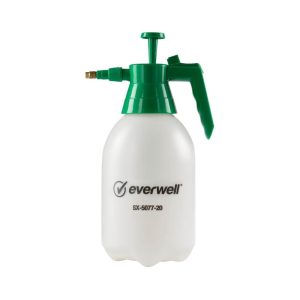
SSP - HAND SPRAYER (1/2 GAL)
SKU · SSP$15.75View details → - In Stock
 Yellow Jacket
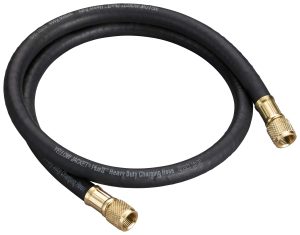
15660 - REFRIGERANT HOSE (3/8" HOSE, 5' LONG)
SKU · 15660$70.98View details → - In Stock
 Tolsen
33003 - MINI TUBING CUTTER (1/8-7/8)
SKU · 330522$7.99View details →