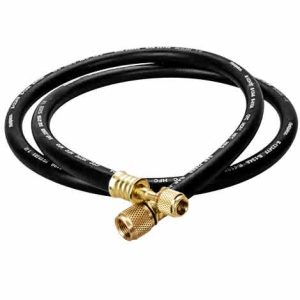
QT1110 – LINE SET FLUSH TOOL
Hold it before you buy it. A nut driver that is a hair loose on a 5/16 hex head will round that head off inside a blower housing in a 140 degree attic, and you just lost an hour you did not have. Spend real money on the tools your hands are on all day - drivers, cutters, flaring tool - and buy cheap on the ones you touch twice a year. Bring your old flaring tool in and compare the cone action against an eccentric one on our counter.
10226 Plano Rd, Suite 104, Dallas TX 75238
Questions? Call or text (214) 340-9421
Mon–Fri 10 am – 7 pm | Sat 10 am – 3 pm
Line Set Flush Tool, a reusable accessory that provides a temporary injection point into piping and line sets for Qwik System Flush where no flare fitting exists. The tool is placed into the line set at the point of injection and the charging hose from the Can Access Valve (QT1105) attaches to it. Unlike the QT1106 QwikNozzle it has no squeeze trigger – flow is controlled at the Can Access Valve knob.
Specifications published by the manufacturer. Source: manufacturer documentation.
Specs
- TypeLine set flush tool / access fitting
- ReusableYes
- Use withQwik System Flush QT1100 / QT1130 via Can Access Valve QT1105
- ManufacturerMainstream Engineering (QwikProducts)
Cross-reference numbers
This part replaces the following OEM and aftermarket numbers:
- 4300-50
Not sure if your number matches? Call (214) 340-9421 or bring the old part in — bench-testing is free.
Is a big 100-piece tool kit a good way to start?
Not for the tools you actually touch all day. Buy the handful you reach for fifty times a week by fit and feel, and let a cheap set cover what you use twice a year. The ones that earn their spot in a service bag are a 1/4 inch and a 5/16 inch nut driver (that pair opens almost every panel on a Rheem, Trane or Goodman), a sharp tube cutter, a ratcheting service wrench with 3/16, 1/4, 5/16 and 3/8 square drives, a fin comb, a stubby driver for tight blower decks and a magnetic bit holder.
What is wrong with the flaring tool in a cheap kit?
The plain bar-and-cone type screws the cone straight into the copper, work-hardens the flare face and does not hold the tube square. An eccentric or clutch-style flaring tool orbits the cone and burnishes a smooth 45 degree face that seals. Ream the cut first, but do not over-ream and thin the lip. One drop of refrigerant oil or Nylog on the face, and never Teflon tape or thread dope on a flare - the seal is metal to metal, per HVAC School's own flaring guidance.
How hard should I crank a tube cutter?
Barely. Light pressure, a quarter turn at a time, all the way around. Cranking it down out-of-rounds the tube and rolls a burr inside that never fully reams out. Replace the wheel when it starts tracking instead of cutting. A hacksaw has no business on refrigerant tubing - the filings go inside and end up in the compressor.
Do I need a swaging tool?
If you work soft copper, yes. A swage expands one tube end into a socket so you braze one joint instead of two and skip the coupling. Fewer joints means fewer leaks.
- Low StockPhoto coming soon
500R - SHEET METAL…Universal500R - SHEET METAL HAMMER
SKU · 500R$27.99View details → - Low Stock
 Fieldpiece
HV1S - REFRIGERANT HOSE (3/8" x 1/4" HOSE, 5' LONG)
SKU · HV1S$65.45View details → - In StockToughBuilt
TB-H4-60-SOL - AVIATION SNIPS (STRAIGHT, OFFSET)
SKU · TB-H4-60-SOL$18.99View details → - Low StockMalco
KBHC - BLADE - FG1
SKU · KBHC$12.28View details →