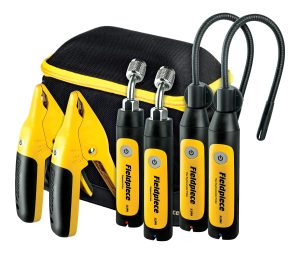
SP2P – MAGNETIC STATIC PRESSURE PROBE (2-PACK)
Never install the micron gauge on the pump's test port. Vacuum falls off as it travels down the hose, so your pump can read 250 microns while the system is still north of 2,000 - and you would swear you were finished. Put the gauge at the system on a core removal tool, run 3/8 inch hoses, and isolate the pump for a decay test. A 1/4 inch hose chokes even a big pump to about half a CFM once you are down at 1,000 microns.
10226 Plano Rd, Suite 104, Dallas TX 75238
Questions? Call or text (214) 340-9421
Mon–Fri 10 am – 7 pm | Sat 10 am – 3 pm
Two-pack of magnetic static pressure probes for taking duct static readings with a manometer; the magnetic flange holds the probe to the duct hands-free. No manufacturer specification sheet was found for this part number.
Specifications from our own stock records. The manufacturer does not publish a public page for this item.
Specs
- Part typeMagnetic static pressure probe
- Quantity2-pack
- Verify before orderingProbe length, hose barb size, manometer compatibility
- Data SourceOTP stock record - not manufacturer-verified
Cross-reference numbers
This part replaces the following OEM and aftermarket numbers:
- UEIASP1
Not sure if your number matches? Call (214) 340-9421 or bring the old part in — bench-testing is free.
Do I need new gauges for R-454B?
Yes for anything the refrigerant touches. R-454B and R-32 are A2Ls, and the equipment makers' own service literature is blunt about it - all service equipment must be A2L rated, and non-rated gear is not to be used. That means an A2L rated manifold and hose set, a non-sparking recovery machine and vacuum pump, a sealed sniffer-style leak detector, and a recovery cylinder labeled for that refrigerant with left-hand threads. Your wrenches and nut drivers are fine. R-410A is the legacy generation now, and a 410A-only manifold does not carry you forward.
Can I charge accurately off analog gauges?
Read trends with them, not targets. A 0 to 500 psi analog face gives you maybe 5 psi of resolution, and at a saturation point 5 psi can be two degrees of subcooling. Use analog to watch a system move - a pump down, a defrost, a suspected restriction. Use a digital gauge or a probe set for weighing in and for superheat and subcooling numbers you intend to act on.
Why can I not just watch the compound gauge for vacuum?
Because it cannot see the range that matters. Full vacuum is 29.92 inches of mercury, and one inch of mercury is roughly 25,400 microns. A needle parked on 29.9 could be at 500 microns or 20,000. A micron gauge is not optional equipment on an evacuation, it is the only instrument that reads the number you are being held to.
What is a passing evacuation?
Pull to 500 microns with the gauge at the system, valve off the pump, and watch the decay. A rise that keeps climbing is a leak. A rise that levels off around 1000 to 1500 is moisture still boiling. Holding under 500 isolated is the pass, not a stopwatch.
- Low Stock
 Fieldpiece
JL3KH6 - WIRELESS REFRIGERANT CHARGE AND AIR TEST KIT
SKU · JL3KH6$788.80View details → - In Stock
 ToughBuilt
TB-H4-60-R - AVIATION SNIPS (RIGHT)
SKU · TB-H4-60-R-6BES$17.99View details → - In StockYellow Jacket
19041 - SEALRIGHT COMPLETE OVERHAUL KIT (LOW LOSS REBUILD)
SKU · 19041$18.45View details → - Low StockANENG
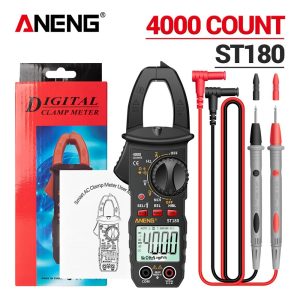
ST180 - CLAMP METER
SKU · ST180$19.90View details →