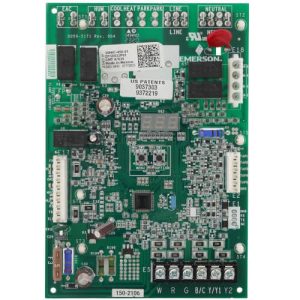
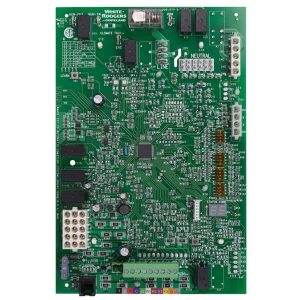
PCBBF162S – CONTROL BOARD
Before you buy a board, hit the fault recall and read what the control already saw. Most store the last four or five codes, and the legend is printed inside the blower door. Then check the 3 amp fuse, the rollout and limit switches, the pressure switch hose, and the flame sensor. Nine times out of ten the board is reporting a failure, not causing one. Photograph every wire and DIP switch before you unplug anything, because boards are non-returnable once installed.
10226 Plano Rd, Suite 104, Dallas TX 75238
Questions? Call or text (214) 340-9421
Mon–Fri 10 am – 7 pm | Sat 10 am – 3 pm
White-Rodgers 50M56-743 integrated furnace control kit — the aftermarket board we stock to replace the Goodman, Amana and Janitrol PCBBF1xx series. Copeland classifies it as a direct OEM replacement, not a universal control. It is a hot-surface-ignition control for 120V Goodman-family gas furnaces with a multi-speed PSC blower, selectable single-stage or two-stage, and it drives the gas valve, nitride igniter, inducer, blower and electronic air cleaner. A diagnostic LED with a FAULT RECALL button stores the last five fault codes.
Before you order
These are split across two Copeland documents — no single sheet lists them all. 50M56-290 is the older White-Rodgers number for the same board and is superseded by this one. Goodman controls sell sheet and heating season cross reference.
Four things all have to be true before this board will work. (1) A Goodman, Amana or Janitrol 120V hot-surface-ignition gas furnace. (2) A multi-speed PSC blower — if your furnace has an X13 constant-torque or a variable-speed ECM motor, this is the wrong board (those take 50M58-707 and 50C51-707 respectively). (3) A non-communicating system — if it is a ComfortNet unit with a 4-wire data link, this board will not work. (4) The number printed on the board you are removing must actually be on the list above. Goodman used many PCBBF numbers on boards that look alike but map to entirely different controls — PCBBF110 / 112 / 123 go to 50A55-743, PCBBF114 / 115 / 116 / 125 to 21M51U-843, PCBBF133 / 137 / 139 to 50M58-707, PCBBF134 / 136 to 50M56-707. Read the old board and check it against the list rather than matching by appearance.
Specs
- ManufacturerWhite-Rodgers (Copeland)
- Manufacturer part number50M56-743
- Control typeIntegrated furnace control, hot surface ignition, nitride igniter
- StagesSingle or two stage, switch selectable
- Blower supportedMulti-speed PSC — COOL / LO HEAT / HI HEAT line-voltage taps
- CommunicatingNo — not a ComfortNet / communicating control
- Line voltage120 VAC, 50/60 Hz
- Low voltage24 VAC nominal (rated 25 VAC on the manufacturer sheet), 50/60 Hz
- Max input current0.45 A
- Igniter relay6.0 A at 120 VAC, resistive
- Gas valve relay1.5 A at 25 VAC, 0.6 PF
- Inducer relay2.2 FLA / 3.5 LRA at 120 VAC
- Circulator relay14.5 FLA / 25.0 LRA at 120 VAC
- Electronic air cleanerDedicated 120 VAC EAC terminals
- Pre-purge30 seconds
- Igniter warm-up17 seconds, rising 1 second per retry to a 19 second maximum
- Trial for ignition4 seconds
- Flame establishing time0.8 second maximum
- Flame failure response2.0 seconds maximum
- Flame sense current1 microamp DC minimum for detection
- Max flame probe wire length36 inches
- Retries / recycles2 retries, 3 recycles
- Interpurge60 seconds
- Post-purge25 seconds
- Lockout275 seconds; 60 minute automatic reset
- Heat fan-on delay30 seconds, fixed
- Heat fan-off delay100 or 150 seconds, DIP selectable (factory 150)
- Cool fan delays6 seconds on, 45 seconds off
- Option switchesSW1-1 heat fan-off delay; SW1-2 single / two stage mode; SW1-3 second stage delay (5 min or Auto)
- Thermostat terminalsR, C, W, Y, G
- DiagnosticsRed LED plus FAULT RECALL button storing the last five faults
- Fuse3 A automotive blade fuse — the only serviceable part on the board
- Operating temperature-40°F to 176°F
- Humidity5% to 93% RH, non-condensing
- Approved gasesNatural, manufactured, mixed, liquefied petroleum and LP-air mixtures
- MountingSnap-in standoffs, any orientation
Cross-reference numbers
This part replaces the following OEM and aftermarket numbers:
- Goodman / Amana PCBBF162
- PCBBF162S Goodman / Amana PCBBF159
- PCBBF159S Goodman / Amana PCBBF132
- PCBBF132S Goodman / Amana PCBBF122
- PCBBF122S Goodman / Amana PCBBF109
- PCB00109 Goodman 0130F00006
- 0130F00006S White-Rodgers 50M56-289
- 50M56-290
Not sure if your number matches? Call (214) 340-9421 or bring the old part in — bench-testing is free.
Fits these models
- GCH950453BXAA, GCH950453BXAB, GCH950453BXAD
- GCH950703BXAA, GCH950703BXAB, GCH950703BXAD
- GCH950704CXAA, GCH950704CXAB, GCH950704CXAD
- GCH950904CXAA, GCH950904CXAB, GCH950904CXAC, GCH950904CXAE
- GCH950905DXAA, GCH950905DXAB, GCH950905DXAD
How do I know the board is actually bad?
Most boards that get replaced were not the problem. Check the on-board fuse first (usually a 3 amp automotive blade), then the rollout and limit switches, the pressure switch and its hose, the flame sensor and the igniter. Then pull the fault history. Most controls from the last 20 years store the last four or five faults, and many have a recall button that scrolls them back. The legend is inside the blower door. If the board powers up, sequences and flashes a code at a switch, it is doing its job.
The 3 amp fuse keeps blowing. Do I need a board?
Almost never. A blown fuse means a short on the 24 volt side, and the most common by far is thermostat wire rubbed through where it crosses sheet metal, at a cabinet knockout or the condenser whip entry. Pull the thermostat wires off the board and the Y wire off the contactor, fuse it, and power up. If it holds, the fault is in the wiring.
Do the DIP switches matter?
Very much. Photograph every switch bank and wire before the old board comes out. Settings cover heat fan off delay (90, 120, 150 or 180 seconds), single or multi-stage stat, conventional or heat pump, and blower signal type. A wrong off delay reads like a bad board.
Is a control board a universal drop-in?
No. A communicating board (ComfortNet, Infinity, Evolution type) will not run a non-communicating system, and the reverse is true too. Stat, outdoor control and board must all speak the same language. Blower type matters too. PSC boards switch 120V speed taps, X13 boards send 24 volts to a torque input, variable speed boards send a serial signal. Boards are non-returnable once installed, so bring the model number in.
- Low Stock
 Trane
TraneCNT09646 - CONTROL BOARD (OEM, TRANE, S8X1 SERIES)
SKU · CNT07639$207.23View details → - Low StockPhoto coming soon
HK32EA008 - DEFROST BOARD…CarrierHK32EA008 - DEFROST BOARD (1185790)
SKU · HK32EA008$259.11View details → - Low StockLennox
16D74 - TIME DELAY RELAY (LENNOX)
SKU · CT1S45$80.14View details → - Low StockWhite-Rodgers
PCBKF105FS - CONTROL BOARD (AFTERMARKET, DIRECT, 50C51-707)
SKU · PCBKF105S$255.89View details →