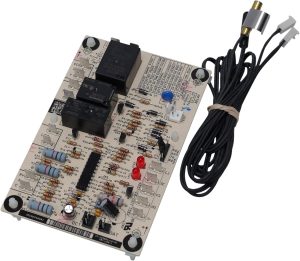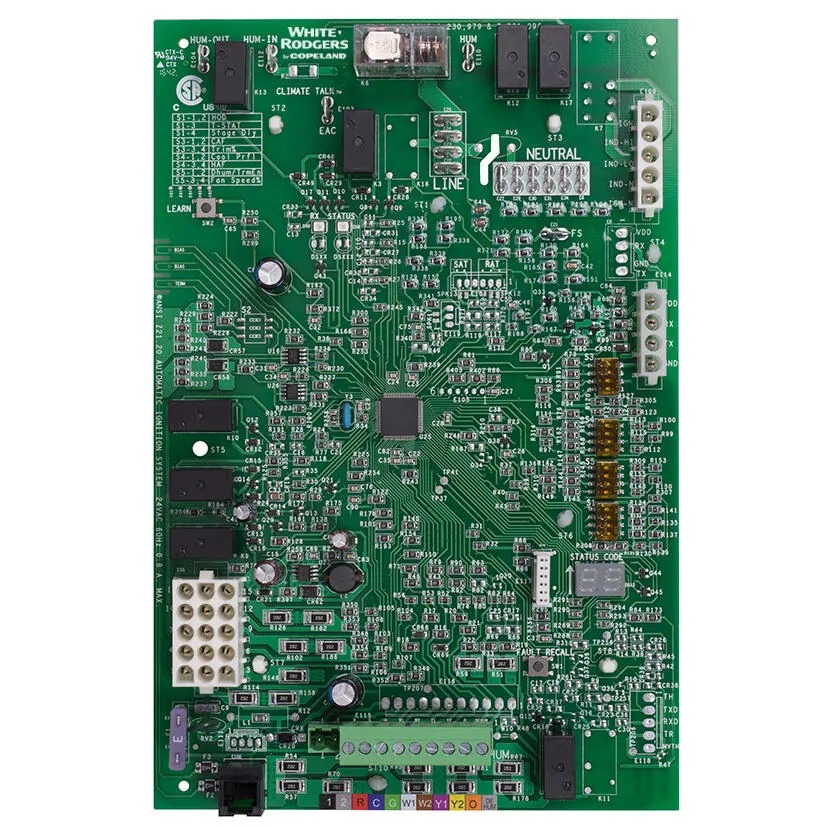
PCBKF105FS – CONTROL BOARD (AFTERMARKET, DIRECT, 50C51-707)
Before you buy a board, hit the fault recall and read what the control already saw. Most store the last four or five codes, and the legend is printed inside the blower door. Then check the 3 amp fuse, the rollout and limit switches, the pressure switch hose, and the flame sensor. Nine times out of ten the board is reporting a failure, not causing one. Photograph every wire and DIP switch before you unplug anything, because boards are non-returnable once installed.
10226 Plano Rd, Suite 104, Dallas TX 75238
Questions? Call or text (214) 340-9421
Mon–Fri 10 am – 7 pm | Sat 10 am – 3 pm
White-Rodgers 50C51-707 two-stage integrated furnace control — the aftermarket board we stock to replace the Goodman and Amana PCBKF1xx series. Copeland classifies it as a direct OEM replacement, not a universal control: it drops into the same standoffs and wiring as the board it replaces. It is a hot-surface-ignition control for two-stage furnaces with a variable-speed ECM blower on a 4-wire motor interface, and it works either as part of a fully communicating ComfortNet system or on legacy 24 VAC thermostat inputs. A two-character 7-segment diagnostic display with fault recall is built in.
Before you order
A note on PCBKF105FS: Goodman superseded PCBKF105S to PCBKF105FS, so that is the OEM number most people search for today. Copeland’s cross reference lists PCBKF105S but has not yet added the FS number, so the honest statement is that this board replaces PCBKF105S, which Goodman now sells as PCBKF105FS. Published cross reference.
The fitment gate is the furnace, not the brand. This board is for two-stage furnaces with a variable-speed ECM blower. It is not a substitute for a single-stage board or for a furnace with a PSC or X13 constant-torque blower — those Goodman applications take different White-Rodgers parts. Before ordering, confirm the board you are pulling out is a PCBKF1xx or a White-Rodgers 50C51-289 / 50C51-290. Set the DIP switches to match the outgoing board — copy its configuration or follow the original furnace manual, then cycle power. Control boards are generally not returnable once installed, so it is worth getting this right before you wire it in.
Specs
- ManufacturerWhite-Rodgers (Copeland)
- Manufacturer part number50C51-707
- Control typeTwo-stage integrated furnace control, hot surface ignition
- Blower supportedVariable speed ECM, 4-wire motor interface
- CommunicationComfortNet 4-wire communicating, or legacy 24 VAC
- Low voltage24 VAC, 60 Hz, Class II
- Control current draw0.8 A at 24 VAC
- Igniter relay4.0 A at 120 VAC, 60 Hz
- Gas valve relays1.5 A at 24 VAC, 0.6 PF (MVL first stage, MVH second stage)
- Inducer relay2.2 FLA / 3.5 LRA at 120 VAC
- Circulator relay13 FLA / 25.0 LRA at 120 VAC
- Humidifier output1.0 A maximum at 120 VAC
- Electronic air cleaner output1.0 A maximum at 120 VAC
- Pre-purge15 seconds
- Igniter warm-up17 seconds, adaptive
- Trial for ignitionUnder 5 seconds
- Flame establishing time0.8 second maximum
- Flame failure response2.0 seconds maximum
- Flame sense current0.3 microamp DC minimum for detection
- Post-purge15 seconds
- Retries / lockout resetInfinite retries; 60 minute auto reset from lockout
- Heat fan-on delay (low heat)30 seconds
- Heat fan-off delay90 / 120 / 150 / 180 seconds, DIP selectable
- Cool fan delays5 seconds on, 45 seconds off
- Continuous fan airflow25% / 50% / 75% / 100%, DIP selectable
- Thermostat terminals1, 2, R, C, W1, W2, Y1, Y2, G, O, DHUM
- DiagnosticsTwo-character 7-segment display, fault recall, flame test pad, network learn button
- Operating temperature-40°F to 175°F
- Humidity5% to 95% RH, non-condensing
- ApprovalsCSA USA / Canada
- GasesNatural, manufactured, mixed, liquid petroleum and LP-air mixtures
Cross-reference numbers
This part replaces the following OEM and aftermarket numbers:
- Goodman / Amana PCBKF101
- PCBKF101S Goodman / Amana PCBKF102
- PCBKF102S Goodman / Amana PCBKF103
- PCBKF103S Goodman / Amana PCBKF104
- PCBKF104S Goodman / Amana PCBKF105
- PCBKF105S White-Rodgers 50C51-289-01
- -289-02
- -289-90 White-Rodgers 50C51-290
- -290-01
- -290-02
- -290-03
Not sure if your number matches? Call (214) 340-9421 or bring the old part in — bench-testing is free.
Fits these models
- DM96VC0403BNAB, DM96VC0603BNAB, DM96VC0603BNAC, DM96VC0803BNAB
- DM96VC0804CNAB, DM96VC1005CNAB, DM96VC1005DNAA, DM96VC1005DNAC, DM96VC1205DNAC
- DC96VC0403BNAA / BNAB, DC96VC0603BNAA / BNAB
- DC96VC0804CNAA / CNAB, DC96VC1005CNAA / CNAB, DC96VC1205DNAA / DNAB
- DM80VC two-stage variable-speed series (Daikin RP-D2301A, a further 22 models)
- GMVC and AMVC 80 and 96 two-stage variable-speed series, including AMVC80805
How do I know the board is actually bad?
Most boards that get replaced were not the problem. Check the on-board fuse first (usually a 3 amp automotive blade), then the rollout and limit switches, the pressure switch and its hose, the flame sensor and the igniter. Then pull the fault history. Most controls from the last 20 years store the last four or five faults, and many have a recall button that scrolls them back. The legend is inside the blower door. If the board powers up, sequences and flashes a code at a switch, it is doing its job.
The 3 amp fuse keeps blowing. Do I need a board?
Almost never. A blown fuse means a short on the 24 volt side, and the most common by far is thermostat wire rubbed through where it crosses sheet metal, at a cabinet knockout or the condenser whip entry. Pull the thermostat wires off the board and the Y wire off the contactor, fuse it, and power up. If it holds, the fault is in the wiring.
Do the DIP switches matter?
Very much. Photograph every switch bank and wire before the old board comes out. Settings cover heat fan off delay (90, 120, 150 or 180 seconds), single or multi-stage stat, conventional or heat pump, and blower signal type. A wrong off delay reads like a bad board.
Is a control board a universal drop-in?
No. A communicating board (ComfortNet, Infinity, Evolution type) will not run a non-communicating system, and the reverse is true too. Stat, outdoor control and board must all speak the same language. Blower type matters too. PSC boards switch 120V speed taps, X13 boards send 24 volts to a torque input, variable speed boards send a serial signal. Boards are non-returnable once installed, so bring the model number in.
- Low Stock
 Carrier
HK42FZ027 - CONTROL BOARD
SKU · HK42FZ027$592.43View details → - Low StockTrane
CNT09648 - CONTROL BOARD (OEM, TRANE, A801X)
SKU · CNT09648$185.50View details → - Low Stock
 Rheem
Rheem47-102684-204 - DEFROST CONTROL BOARD
SKU · 47-102684-204$107.95View details → - Low StockNortek
1016380R - CONTROL BOARD (NORDYNE)
SKU · 1016380R$184.89View details →