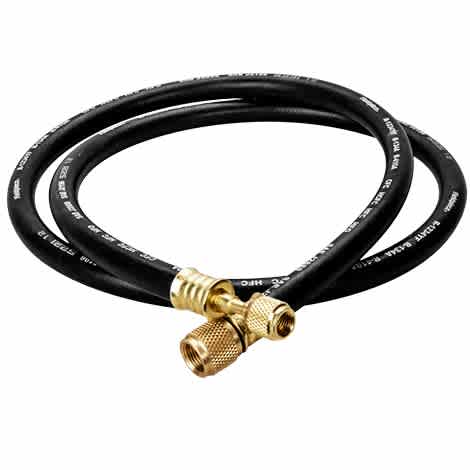
HV1S – REFRIGERANT HOSE (3/8″ x 1/4″ HOSE, 5′ LONG)
A pair of vacuum-rated core removal tools will cut more time off an evacuation than trading up to a bigger pump ever will. Cores and 1/4 inch hoses are the restriction, not displacement. And change the oil warm before the job instead of after - saturated oil quietly raises the pump's ultimate vacuum, and you will spend an afternoon chasing a leak that was really moisture sitting in the crankcase.
10226 Plano Rd, Suite 104, Dallas TX 75238
Questions? Call or text (214) 340-9421
Mon–Fri 10 am – 7 pm | Sat 10 am – 3 pm
Fieldpiece 5 ft evacuation hose with 1/4″ and 3/8″ fittings, so it adapts a 3/8″ vacuum pump port to a 1/4″ manifold or service port without a separate adapter. Built with a full-ring triple crimp at the ends and a permeation barrier meeting SAE J2196. Fieldpiece lists it as A2L compatible. Note that Fieldpiece classifies this as a vacuum/evacuation hose rather than a refrigerant charging hose.
Specifications published by the manufacturer. Source: manufacturer documentation.
Specs
- Length5 ft
- Fittings1/4" x 3/8"
- Working pressure800 psi
- Burst pressure4000 psi
- A2L compatibleYes
- CrimpFull-ring triple crimp
- Permeation barrierMeets SAE J2196
- Intended useEvacuation
Does a bigger pump evacuate faster?
Usually not, because the restriction beats the displacement. A 1/4 inch hose with the Schrader core still in the port chokes even a large pump down to roughly half a CFM by the time you reach 1,000 microns. Put a vacuum-rated core removal tool on each service port, pull the cores, and run 3/8 or 1/2 inch hoses. A 4 CFM pump plumbed that way beats a 6 CFM pump plumbed the lazy way every time. Buy the core tools before you buy the bigger pump.
How often does pump oil need changing?
More often than most people do it, and always while the pump is warm so the contamination drains out with it. Change it when the oil turns creamy (moisture) or dark (acid and debris), when the pump will not reach its blank-off rating, and before any evacuation you actually care about. In the field that runs anywhere from daily to monthly. There is no filter inside a vacuum pump - the oil is the filter, and saturated oil raises the best vacuum the pump can reach.
Can I recover R-454B into my old machine?
No. A2L work calls for a non-sparking recovery machine and a non-sparking vacuum pump, and the cylinder has to be one labeled for that refrigerant, with left-hand threads and a relief valve rather than a rupture disc. Keep the pump exhaust and the machine clear of ignition sources and keep the space ventilated.
How full can a recovery cylinder go?
80 percent by weight, on a scale, never by feel or by sound. And never mix refrigerants in one cylinder - a mixed jug is a disposal problem, not recovered refrigerant.
- Low Stock
 ToughBuilt
TB-KP-2B - FOAMFIT KNEE PADS
SKU · TB-KP-2B-2BES$20.99View details → - Low StockPhoto coming soon
NY-129 - ELECTRICIAN TOOL…UniversalNY-129 - ELECTRICIAN TOOL POUCH
SKU · NY-129$13.99View details → - In StockUniversal
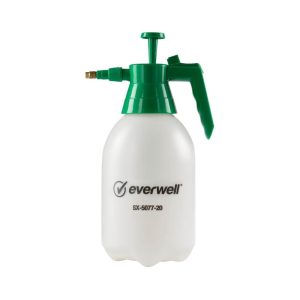
SSP - HAND SPRAYER (1/2 GAL)
SKU · SSP$15.75View details → - Low Stock
 Asco
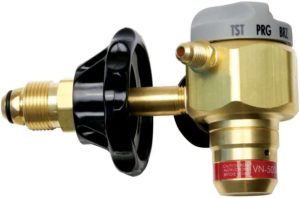
AscoVN500 - NITROGEN BRAZING/PURGING REGULATOR
SKU · VN500$167.90View details →