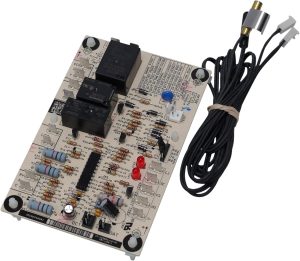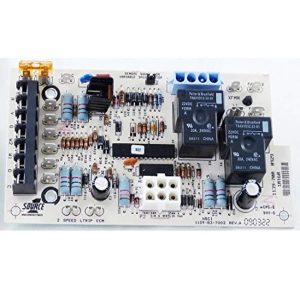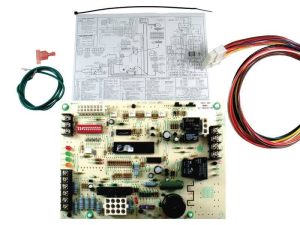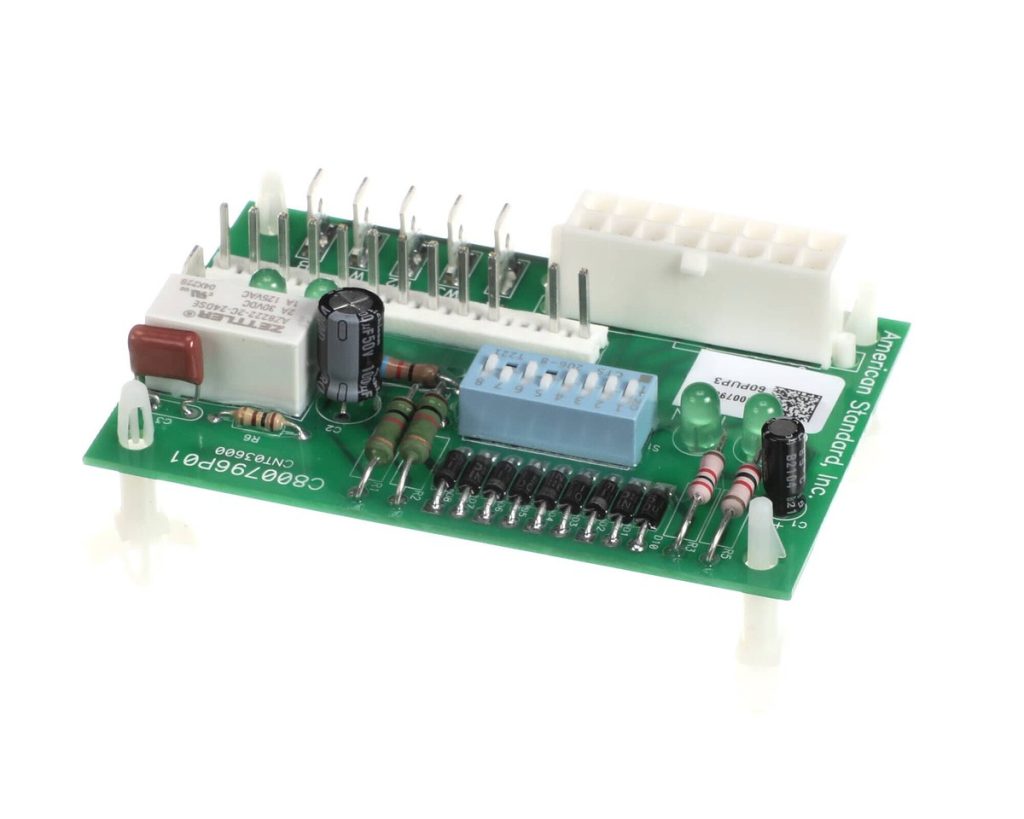
CNT03600 – CONTROL BOARD (ECM, AIR HANDLER)
Before you buy a board, hit the fault recall and read what the control already saw. Most store the last four or five codes, and the legend is printed inside the blower door. Then check the 3 amp fuse, the rollout and limit switches, the pressure switch hose, and the flame sensor. Nine times out of ten the board is reporting a failure, not causing one. Photograph every wire and DIP switch before you unplug anything, because boards are non-returnable once installed.
10226 Plano Rd, Suite 104, Dallas TX 75238
Questions? Call or text (214) 340-9421
Mon–Fri 10 am – 7 pm | Sat 10 am – 3 pm
Symptoms of failure
- No response at all when the thermostat calls
- Board LED flashes a fault code, or shows nothing at all
- Blower runs constantly and will not shut off
- Visible scorch marks, a blown fuse, or a bulged capacitor on the board
- Air handler works intermittently with no pattern
- Relays click on the board but the blower never energizes
Seeing these does not always mean this part is the culprit. Bring the old one in and we will meter it at the counter, free, before you buy.
Trane/American Standard OEM printed wiring board with a 16-pin connector. Trane Supply lists the part with the description “CONTROL; ICM FAN, PWB, 16 PIN” and files it under Furnace Control Boards. Trane publishes no voltage, amperage or model-fitment list for this part number to guests, so confirm the application against the equipment’s wiring diagram before installing.
Specifications published by the manufacturer. Source: manufacturer documentation.
Specs
- Trane descriptionCONTROL; ICM FAN, PWB, 16 PIN
- Connector16 pin
- Trane Supply categoryControls > HVAC Equipment Controls > Heating Controls > Furnace Control Boards
Installing it yourself
- Kill power at the air handler disconnect and confirm 0V at the board before touching it.
- Photograph EVERY connector before you unplug anything. This is the step people skip and regret.
- Check the obvious first - a blown 3A fuse, a tripped float switch, a bad ground. Most boards that get replaced were not the problem.
- Move connectors one at a time from the old board to the new one so you cannot cross them.
- Transfer any jumper or DIP settings exactly; on an ECM air handler those set blower speed and delay profiles.
- Restore power and watch a full cycle - call for fan, then heat, then cool - before you close it up.
Power off at the disconnect first, every time. Not sure partway through? Bring it to the counter and we will walk it with you.
Cross-reference numbers
This part replaces the following OEM and aftermarket numbers:
- C800796P01
- CNT3600
Not sure if your number matches? Call (214) 340-9421 or bring the old part in — bench-testing is free.
How do I know the board is actually bad?
Most boards that get replaced were not the problem. Check the on-board fuse first (usually a 3 amp automotive blade), then the rollout and limit switches, the pressure switch and its hose, the flame sensor and the igniter. Then pull the fault history. Most controls from the last 20 years store the last four or five faults, and many have a recall button that scrolls them back. The legend is inside the blower door. If the board powers up, sequences and flashes a code at a switch, it is doing its job.
The 3 amp fuse keeps blowing. Do I need a board?
Almost never. A blown fuse means a short on the 24 volt side, and the most common by far is thermostat wire rubbed through where it crosses sheet metal, at a cabinet knockout or the condenser whip entry. Pull the thermostat wires off the board and the Y wire off the contactor, fuse it, and power up. If it holds, the fault is in the wiring.
Do the DIP switches matter?
Very much. Photograph every switch bank and wire before the old board comes out. Settings cover heat fan off delay (90, 120, 150 or 180 seconds), single or multi-stage stat, conventional or heat pump, and blower signal type. A wrong off delay reads like a bad board.
Is a control board a universal drop-in?
No. A communicating board (ComfortNet, Infinity, Evolution type) will not run a non-communicating system, and the reverse is true too. Stat, outdoor control and board must all speak the same language. Blower type matters too. PSC boards switch 120V speed taps, X13 boards send 24 volts to a torque input, variable speed boards send a serial signal. Boards are non-returnable once installed, so bring the model number in.
- Low Stock
 Rheem
Rheem47-102684-204 - DEFROST CONTROL BOARD
SKU · 47-102684-204$107.95View details → - Low Stock
 York
YorkS1-03101264002 - CONTROL BOARD (YORK, ELEC, MOBILE HOME)
SKU · S1-03101264003$342.48View details → - Low Stock
 ProTech
62-102637-81 - CONTROL BOARD
SKU · 62-102637-81$313.43View details → - Low Stock
 Carrier
ICM271C - CONTROL BOARD (CARRIER)
SKU · HH84AA010, HH84AA011, HH84AA012, HH84AA013, HH84AA020$154.08View details →