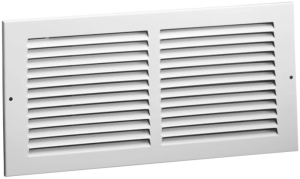
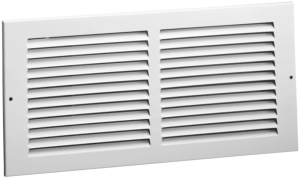
RND-DIFF-06 – ROUND DIFFUSER
Order by the duct opening, not the face - a 12x6 register fits a 12x6 opening and measures about 13-5/8 by 7-5/8 overall. Measure the hole or bring the old grille in. And if you are fighting weak airflow in an older Dallas house, add up your return free area before you touch the charge. One 20x20 stamped return is roughly 2 tons of air, and a lot of 3 and 4 ton systems in this town are trying to breathe through a single one.
10226 Plano Rd, Suite 104, Dallas TX 75238
Questions? Call or text (214) 340-9421
Mon–Fri 10 am – 7 pm | Sat 10 am – 3 pm
Round ceiling diffuser for supply air distribution. The part number indicates a 6 in. neck.
Specifications from our own stock records. The manufacturer does not publish a public page for this item.
Specs
- TypeRound ceiling diffuser
- Nominal size6 in. (read from the part number - verify)
- CategoryRegisters, grilles and diffusers
- Data SourceOTP stock record - not manufacturer-verified
Cross-reference numbers
This part replaces the following OEM and aftermarket numbers:
- DF3W-6
Not sure if your number matches? Call (214) 340-9421 or bring the old part in — bench-testing is free.
Which dimension do I order by?
The duct opening, always. A register or grille is sized to the hole it covers, and the outside flange runs bigger to hold it in place. A Hart and Cooley 12x6 sidewall register fits a 12x6 wall opening and measures 13-5/8 by 7-5/8 on the face. Measure the opening, or bring the old one in with you, and give us that number - not what you read across the face.
What do throw and spread mean?
Throw is how far the air stream carries before it slows down to nothing useful. Spread is how wide it fans out. You want throw that reaches the exterior wall and washes the window, because that is where the heat is coming in, and adjustable-blade bar registers let you set the spread. Supply face velocity of roughly 500 to 800 fpm is the working range, with about 700 a common target. Push much past that and you can hear it.
How big does a return grille have to be?
Bigger than what is probably up there now. Design for 400 CFM per ton with return static under 0.08 inches of water column, and hold return face velocity to 400 to 600 fpm, or 300 to 450 fpm on a filter grille. A 20x20 return is 400 square inches gross, but a stamped face is only about 70 percent free area, so call it 280 net - about 2 tons of air. Plenty of 3 and 4 ton houses around here breathe through exactly that one grille.
So the return is usually the real problem?
Usually. ACCA cites studies putting 80 percent of homes on undersized return duct systems. High static starves the coil, and in DFW that shows up as weak cooling in August, a sweating plenum, and a system that never delivers full capacity on a perfectly correct charge.
- In Stock
 Venti
VentiSR1008-1W - SUPPLY REGISTER (10" x 8", 1-WAY, ADJUSTABLE)
SKU · SR1008-1W$21.12View details → - In Stock
 ProGrille
RG1206 - RETURN GRILLE (12"W x 6"T)
SKU · RG1206$8.97View details → - In StockProGrille
RG1414 - RETURN GRILLE (14" x 14")
SKU · rg1414$16.35View details → - In Stock
 ProGrille
FG2516 - FILTER GRILLE (25"W x 16"T)
SKU · FG2516$38.70View details →