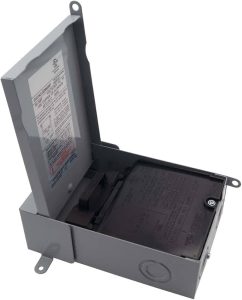
D322NRB – DISCONNECT (NEW, UNBOXED, OLD STOCK)
Bring the old pull-out or a photo of the unit nameplate. The plate tells you whether the unit wants fuses (it lists a maximum fuse size) or allows an HACR breaker, and that is what decides fusible versus non-fusible. Guessing is how people end up with the wrong block. While it is apart, look hard at the stabs and jaws, because pitted, browned contacts in a pull-out cause more one-leg no-start calls than most people expect and a new disconnect is cheap. Shut off the breaker and pull the block first.
10226 Plano Rd, Suite 104, Dallas TX 75238
Questions? Call or text (214) 340-9421
Mon–Fri 10 am – 7 pm | Sat 10 am – 3 pm
Square D (Schneider Electric) general duty fusible safety switch rated 60 A at 240 VAC, 3-pole/4-wire with a factory-installed neutral, in a Type 3R rainproof enclosure with bolt-on hub provision. It provides a lockable local disconnecting means plus fuse overcurrent and short-circuit protection for outdoor HVAC and light commercial loads, and uses a quick-make, quick-break operating mechanism.
Specifications published by the manufacturer. Source: manufacturer documentation.
Before you order
Square D numbering, so you can check what you have: a leading D means fusible, DU means non-fusible. Then 3 poles, voltage class 2 (240 V), amp code 2 (60 A). The suffixes are N for a factory-installed solid neutral, R for the Type 3R rainproof enclosure, and B for the bolt-on hub provision. So D322NRB is the fusible one.
The non-fusible equivalent is DU322RB, and note it is 3-wire with no neutral, so the two are not a straight swap if your install uses that neutral. This unit ships without fuses; it takes Class H or K up to 60 A, or Class R with the RFK03H rejection kit.
Specs
- BrandSquare D / Schneider Electric
- TypeGeneral duty fusible safety switch
- Amperage60 A
- Voltage240 VAC
- Poles / wires3-pole, 4-wire
- NeutralFactory-installed
- Horsepower15 hp at 240 VAC
- EnclosureNEMA/Type 3R, bolt-on hub provision
- ListingUL listed
Does code require a disconnect at the outdoor unit?
Yes. NEC 440.14 puts the disconnecting means within sight from and readily accessible from the equipment. Article 100 defines within sight as visible and not more than 50 feet away, so a breaker in a garage panel around the corner does not satisfy it. The 2023 code also pulls in the working space rules of 110.26(A). You cannot mount it where it blocks a service panel or hides the nameplate.
Fusible or non-fusible?
Read the unit nameplate. If it lists a maximum fuse size, or calls for fuse protection, use a fusible pull-out or fused safety switch with the fuses that plate specifies. If the plate allows HACR breaker protection and the branch breaker already provides it, a non-fused pull-out is fine, and that is what most DFW residential splits use. Never fuse above the nameplate maximum to stop a nuisance trip. That number protects the compressor windings, not the wire.
The pull-out looks fine but the unit is dead.
Pull the block and look at the stabs and jaws. Heat and humidity pit them, and a pitted stab makes resistance, then heat, then one dead leg. A unit that hums and will not start, or a compressor pulling on one leg, is often a burned disconnect. They are cheap and we stock them. Check the block is not in upside down, since some are directional.
How do I make it safe to work on?
Shut off the breaker at the panel and pull the disconnect block. That is it. Verify dead with a meter at the line side of the contactor before your hands go in. Never poke at capacitor terminals with a screwdriver. A run capacitor stays wired across the motor windings, so cutting power bleeds it off through the winding within seconds.
- In Stock
 Trueline
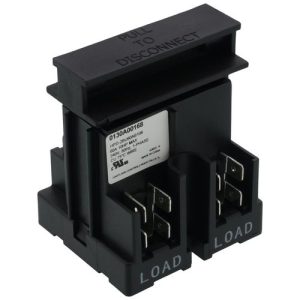
SDB60NF - DISCONNECT SWITCH (60A, NON-FUSED, PULL OUT)
SKU · DPU222R$17.49View details → - Low Stock
 Goodman
BT1753510S - DISCONNECT
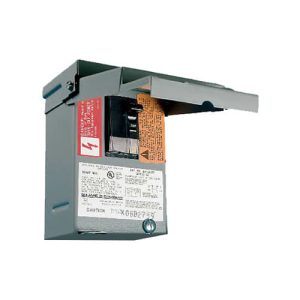
SKU · Bt1753510S$38.35View details → - Low StockSquare D
Q0200TR - DISCONNECT (SQUARE D, SWITCH STYLE)
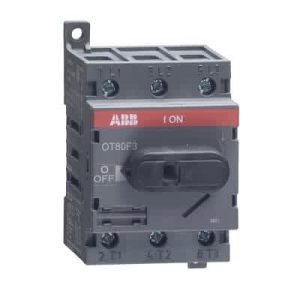
SKU · U065NA1$31.01View details → - Low StockABB
OT80F3 - DISCONNECT
SKU · OT80F3$80.00View details →