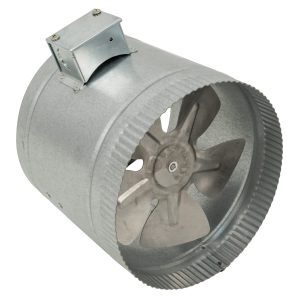
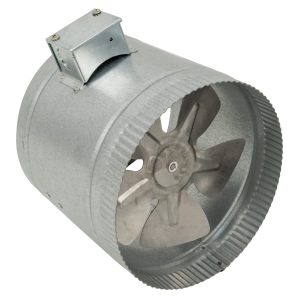
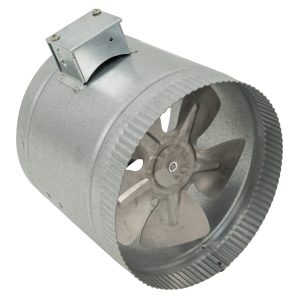
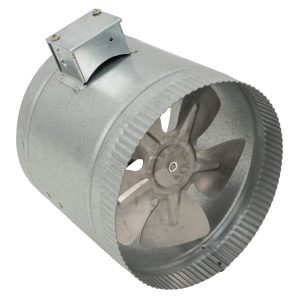
AS1 – AIR TRANSFER FAN
Before you buy a booster, put a manometer on the system and check the filter, the flex runs in the attic and the boot connections in that room. Most hot-room complaints around DFW turn out to be a crushed or disconnected flex duct baking in a 140F attic, and no booster fan fixes a duct that is kinked shut. If a booster really is the answer, size it to the branch diameter, wire it to run with the blower off a current sensing relay, and mount it well away from the register.
10226 Plano Rd, Suite 104, Dallas TX 75238
Questions? Call or text (214) 340-9421
Mon–Fri 10 am – 7 pm | Sat 10 am – 3 pm
Tjernlund AireShare Model AS1 room-to-room transfer fan. A low-sone cross-flow blower moves conditioned air through the wall cavity into an adjacent room, with a diffuser that includes a built-in turning vane and a 15-degree discharge deflector. Hard wired, with no cord exposed outside the wall.
Specifications published by the manufacturer. Source: manufacturer documentation.
Specs
- BrandTjernlund
- ModelAS1 AireShare
- BlowerVibration-isolated cross-flow, factory balanced
- Sound1.5 sones max
- Power30 watts max, 120 VAC hard wired
- Construction20-22 ga aluminized steel, satin white powder coat
- MotorC-frame, bearings rated 32,000 hours
- ListingsANSI/UL 507; CSA C22.2 #113-M
Cross-reference numbers
This part replaces the following OEM and aftermarket numbers:
- R2R
Not sure if your number matches? Call (214) 340-9421 or bring the old part in — bench-testing is free.
Will an inline duct booster fan fix my hot back bedroom?
Sometimes, but it is the last thing to try, not the first. A booster only earns its keep when that one branch is genuinely undersized or very long and the rest of the system is healthy. If the real cause is a loaded filter, a kinked flex run, a boot that fell off in the attic, a closed damper or a blower not moving its rated CFM, a booster just adds noise to the same restricted air. Measure total external static pressure before you buy one.
What is the myth here?
That a booster adds airflow to the system. It does not. It can only redistribute what the air handler already delivers to that branch. Put a small booster in series with a blower that already develops more pressure than the booster can, and the booster becomes a restriction. Size it to the duct diameter and compare its CFM rating at actual static pressure, never the free-air number on the box.
How should it be switched on?
Three common ways: a current sensing relay on the blower leg, a sail switch in the duct, or a plug-in current sensor. Wiring it to run with the blower is the clean way. Do not let it run independently of the air handler or you will pull attic air and dust in through the duct joints.
Where does it mount?
In the branch it serves, as far from the register as practical so you do not hear it, on rigid or hard-jointed duct, with the airflow arrow pointed toward the register. Support the fan so the duct is not carrying its weight, and seal both collars with mastic or foil tape, not cloth duct tape.
- Low Stock
 Packard
DF9006 - DUCT FAN (120V, 6")
SKU · DF9006$66.86View details → - Low StockDiversiTech
DF9010 - DUCT FAN (120V, 10")
SKU · DF9010$108.77View details → - Low StockDiversiTech
DF9008 - DUCT FAN (120V, 8")
SKU · DF9008$76.17View details → - Low StockDiversiTech
DF9012 - DUCT FAN (120V, 12")
SKU · DF9012$130.86View details →