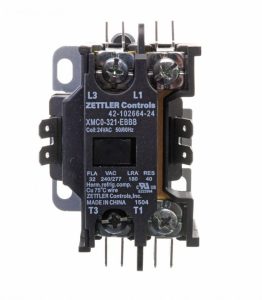
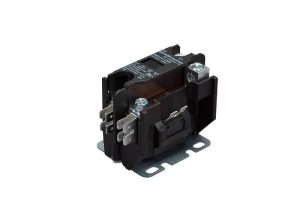
1P40A24V – CONTACTOR (C140A)
When you swap a contactor, also pull the capacitor and bring both in — pitted contactor contacts almost always mean the cap was weak and the compressor was straining to start. We'll test the cap free, and if it's marginal you'll save yourself a second trip.
10226 Plano Rd, Suite 104, Dallas TX 75238
Questions? Call or text (214) 340-9421
Mon–Fri 10 am – 7 pm | Sat 10 am – 3 pm
Symptoms of failure
- AC will not start and you hear a buzz or chatter at the contactor
- Contacts look pitted, blackened, or welded together
- Unit runs constantly and will not shut off when the thermostat is satisfied
- Loud chattering from the outdoor unit that comes and goes
- Ants or debris packed around the contacts
- Thermostat calls for cool and nothing happens outside
Seeing these does not always mean this part is the culprit. Bring the old one in and we will meter it at the counter, free, before you buy.
If your AC clicks but doesn’t start, or the outdoor unit won’t turn on at all, the contactor is the first thing to check. The contactor is the electrical switch inside your outdoor unit that sends power to the compressor when the thermostat calls for cooling. This single-pole 40A model with a 24V coil fits most residential systems.
Replaces: C140A, 1P40A24V, CONT1P025024V, CONT1P030024V, CONT2P025024VS, SE6968M
Fits: Goodman: GSX140481KD; also fits most residential AC systems requiring a 1-pole 25-40A contactor with 24V coil
Need help? See our AC Clicking But Not Starting Guide.
In stock at Open To Public HVAC Parts in Dallas. We test parts at the counter before you buy. Call or text (214) 340-9421.
Specs
- Poles1
- Amps40 RLA (full load)
- Coil Voltage24V AC
- TerminalsScrew + push-on quick-connect
- Operating Temp-40°F to 158°F
- UL ListedYes
Installing it yourself
- Kill power at the disconnect and confirm 0V.
- Photograph the wiring first. Line, load and the 24V coil all land in specific places.
- Move one wire at a time from old to new so you cannot cross them.
- Match pole count, coil voltage (usually 24V) and FLA rating. FLA is the number that matches a compressor, not the resistive rating.
- A 2-pole is a safe upgrade over a 1-pole with shunt. Going the other way is not.
- Mount, land the wires, restore power.
- If it chatters again with a new contactor, the problem is low control voltage, not the contactor.
Power off at the disconnect first, every time. Not sure partway through? Bring it to the counter and we will walk it with you.
Cross-reference numbers
This part replaces the following OEM and aftermarket numbers:
- 1P40A24V
- 42-20619-01
- 42-25035-01
- 42-25101-03
- 42-42478
- 42-42478-02
- C147094P02
- CONT1P025024V
- CONT1P030024V
- CONT2P025024VS
- CONTACTOR
- CTR02574
- DP1040A5004
- GSX140481KD
- H140A
- SE6968M
Not sure if your number matches? Call (214) 340-9421 or bring the old part in — bench-testing is free.
Fits these models
- Rheem / Ruud RA13, RA14, RA16 series condensers
- Goodman / Amana / Daikin GSX13, GSX14, GSX16 series
- Trane XR13, XR14, XB13, XB14 (verify nameplate)
- Carrier / Bryant / Payne 13-14-16 SEER
- Lennox 13ACX, 14ACX, ML14XC1 series
- York / Coleman entry-level residential condensers
- Standard residential 24V control circuit (most split-system AC and heat pumps)
- Verify amp rating + coil voltage on the existing contactor before swapping
How do I know if my contactor is bad?
Pitted or burned contacts, a buzzing sound when the AC tries to start, or the contactor sticking closed (AC runs constantly, never cycles off). Pull the front cover and look at the contacts — if they're black or pitted, replace it.
Can I use a higher amp rating?
Yes. Going up in amps is fine (40A replacing a 30A is safe). Coil voltage MUST match exactly — 24V coil only goes in 24V circuits.
2-pole vs 3-pole — which do I need?
Count the thick wires hitting the line side (top). 2 fat wires = 2-pole (residential split-system). 3 fat wires = 3-pole (3-phase commercial). Most residential is 2-pole.
How long does a contactor last?
5-10 years typical. Insects, dust, and short-cycling shorten the life. If you find ants or wasps nesting in your condenser, that often kills contactors fast.
- In Stock
 Rheem
Rheem1P32A24V - CONTACTOR (SCREW TERMINALS)
SKU · 42-109499-24$30.70View details → - In Stock
 Supco
Supco3P40A120V - CONTACTOR (3 POLE, 40 RLA, 120V COIL)
SKU · DP401203$35.95View details → - Low Stock
 Packard
2P40A240V - CONTACTOR (C240C)
SKU · C240C$36.01View details → - In Stock
 ProTech
42-102664-10 - CONTACTOR (1 POLE, 24V COIL, 40 AMP, SCREW & LUG TERMINALS)
SKU · 42-102664-10$33.51View details →