What Size AC Capacitor Do I Need? A Complete Sizing Guide
¿Prefiere leer esto en español? Vea esta guía en español →
The wrong capacitor is the most common part mistake we see at the counter, and it is almost always the same story: somebody looked up their tonnage, bought what a chart told them, and put a capacitor in that the motor never asked for.
Tonnage is not what sizes a capacitor. Here is what actually does, where the real number is written on your equipment, and what to do when the label is too cooked to read.
The short answer: the number is written in two places
Your capacitor’s size is not something you calculate or look up by system size. It is a specification of the motors it serves, and it is printed on the equipment. Two places to look, in this order:
1. The old capacitor itself
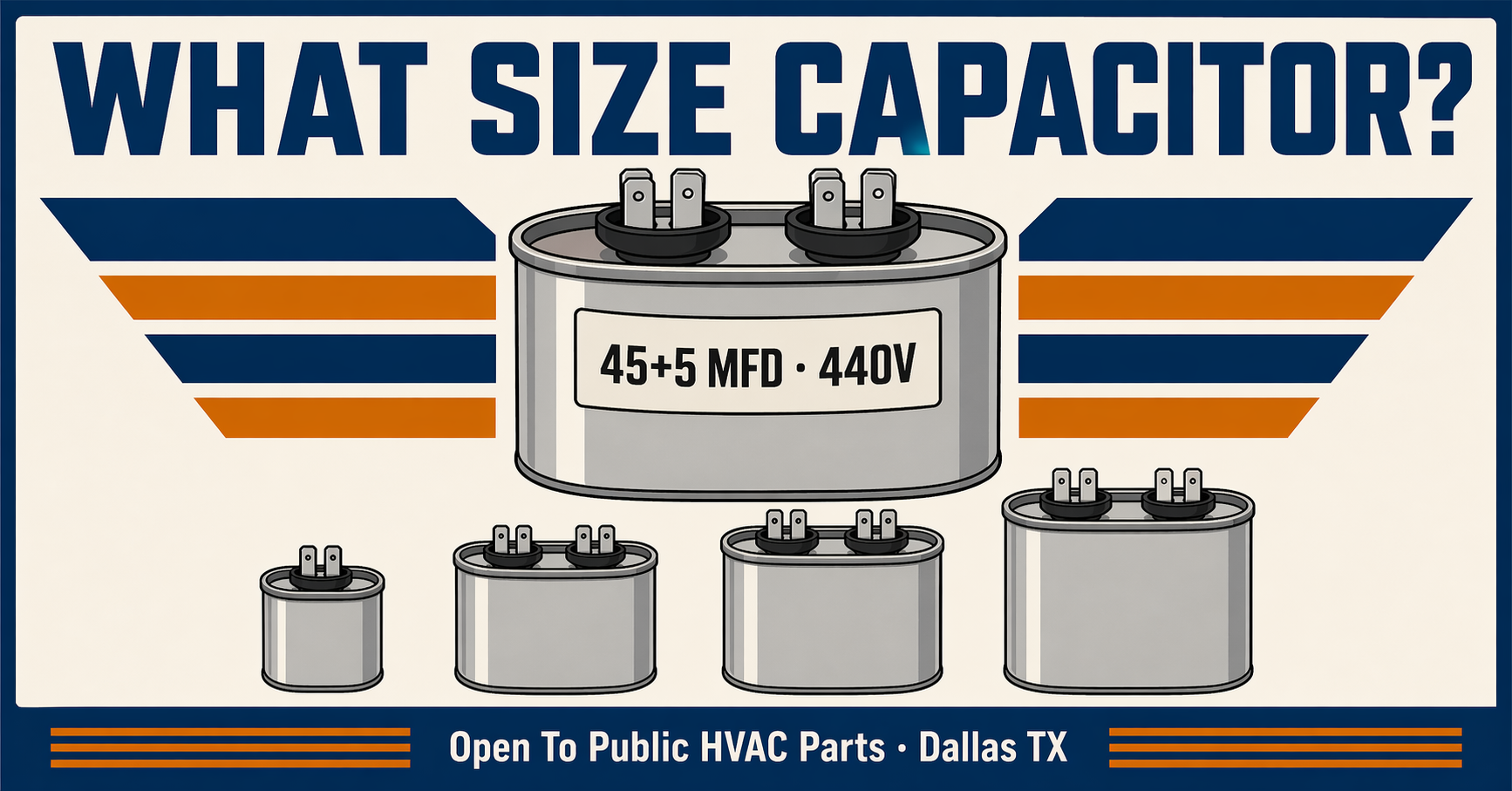
The label carries everything you need: the microfarad value (written MFD or µF), the voltage, and on a dual capacitor, both values. A dual reads something like 45/5 µF 370/440VAC — 45 for the compressor, 5 for the condenser fan.
This is the authority. Whatever is printed on the part that came out is what goes back in.
2. The condenser data plate
If the capacitor label is unreadable — and after a few Dallas summers they often are, because the top of a capacitor is the hottest real estate in the cabinet — the outdoor unit’s data plate lists the required values. Look for lines reading CAP, RUN CAP, COMP CAP or FAN CAP, usually near the compressor RLA and LRA figures.
The plate is on the side or back of the condenser, near where the copper lines connect. Take a photo of the whole plate rather than writing numbers down — stamped plates in bad light are exactly where a 5 turns into a 6.
If both are gone
The compressor and the fan motor each carry their own nameplate with their own required capacitance, and the fan motor’s is usually still legible because it sits out of the direct heat. Failing that, the model number off the data plate will get you there — bring it to us, or use our model number lookup to identify the system first.
What you should not do is guess from tonnage. Which brings us to the chart everybody publishes.
Why “what size capacitor for a 3 ton” doesn’t have one answer
Search that question and you will find a tidy table telling you a 3 ton takes 45/5 and a 5 ton takes 60/5, with the “check your plate” caveat somewhere below the fold.
We are not going to publish one of those, and we want to be straight about why: there is no set capacitor size for a tonnage. We have a counter full of these parts and we sell them all day, and we still will not guess at one — because guessing is pointless and probably wrong, and the person who gets it wrong pays for it with a compressor.
The run capacitor is sized to the compressor’s motor windings, not to the cooling capacity of the system. Two condensers of the same nominal tonnage can use meaningfully different capacitors, because:
- Different compressors. A scroll and a reciprocating compressor of the same tonnage are different motors with different start and run characteristics.
- Different efficiency tiers. A 14 SEER and a 17 SEER 3 ton are not built on the same compressor. Higher efficiency generally means a physically different motor, and the capacitor follows the motor.
- The fan side is independent. The second number on a dual is the condenser fan motor, and that is chosen by the fan motor manufacturer with no reference to system tonnage at all.
- Two-stage and variable-speed equipment may not use a conventional run capacitor arrangement in the first place.
This is the same problem as nominal tonnage itself, which we get into on the model number lookup page: the number a system is sold under tells you less about the hardware inside it than people assume.
The only way around not knowing your size
There is exactly one honest answer for somebody who genuinely cannot read their old capacitor and cannot get to the data plate, and it is a universal capacitor — a Turbo 200 or 200X. These are multi-value capacitors: you wire to the tap that matches the value you need, and one part covers a wide range.
We stock them and they work. Two things to know before you decide that is the easy way out:
- They cost considerably more than the single correct capacitor. You are paying for the range.
- They confuse people. A universal has a row of labelled taps instead of two or three plain terminals, and if you did not know your value to begin with, a part that requires you to select your value has not solved your problem.
If you know your number, buy your number. The universal is for the case where the label is gone and the plate is gone and you need the unit running today — not a shortcut around finding out what you have.
Can I use a bigger capacitor? No — and this is the one that costs money
This is the question we get asked most, usually phrased as “they only had a 50, will that work instead of the 45?”
No. Match the microfarad value exactly.
A run capacitor is not a battery and bigger is not stronger. The capacitor sets the phase shift on the motor’s start winding. Oversize it and you push more current through that winding than it was designed to carry, continuously, every minute the unit runs. The motor may well start easier on day one — which is exactly why this mistake feels like it worked — and then run hot for a season and fail.
On a compressor, that failure is the whole outdoor unit. A capacitor is a twenty dollar part; a compressor is a system replacement conversation. It is a bad trade to make to save a trip.
Undersizing is no better: too little capacitance means the motor draws high amps trying to come up to speed, trips the overload, and cooks the winding from the other direction.
The specific version of this question we hear constantly — can I replace a 45/5 with a 50/5? — is the same answer. The 5 matches, the 45 does not. Get the 45.
The one substitution that is fine
Voltage. See below. That one goes up freely.
How far off is actually “bad”?
If you are testing a capacitor rather than replacing one blind, the threshold most people get wrong is that build tolerance and replacement threshold are two different numbers.
Manufacturers publish a build tolerance — Packard Titan PRO and Titan HD are ±5%, Genteq ±6%, Aerovox ±10%. That is how far a brand new part is allowed to be from its label. It is not the point at which a used one is condemned.
The working replacement threshold is 10% below the rated value. A 45 MFD capacitor reading below roughly 40.5 is done, regardless of what the build tolerance was.
And capacitance is not the only way they fail. A capacitor that meters perfectly can still be finished if it has a bulging or domed top, is weeping oil, has corroded or loose terminals, or has developed high internal resistance. Some fail high rather than low. If the can is not flat and clean, replace it whatever the meter says.
Bring the old one to our counter and we will meter it free before you buy anything — no purchase needed.
370V vs 440V: up is always fine, down never is
The voltage rating is a maximum withstand rating, not an operating requirement. The capacitor does not “put out” its voltage; it survives up to it.
- Going up is always safe. A 440V part in a circuit that specified 370V runs at about 84% of its rating and will generally last longer for it.
- Going down is never acceptable. A 370V part in a 440V application is an early failure with a real chance of venting.
- “370/440” is a 440V capacitor. It is not switchable and it is not two modes. Manufacturers started stamping both numbers because so many people assumed a 440 could not replace a 370.
The one real cost of a voltage upgrade is physical: the can gets taller. Aerovox’s own dimension tables put 15 MFD at 370V in a 1.25″ oval at 3.25″ tall, and the same 15 MFD at 440V at 4.13″. In a tight condenser cabinet, that inch is the actual reason a free upgrade will not fit. Check your clearance before you assume up is free.
Single, dual, round, oval
Two mechanical questions that get treated as electrical ones:
Single vs dual is about how many motors the capacitor serves. A dual has three terminal posts — HERM for the compressor, FAN for the condenser fan, and C for common — and does the job of two capacitors. A single has two posts and serves one motor. A dual can be replaced by two singles of the matching values if that is what is on the shelf and there is room to mount them; two singles cannot be replaced by a dual unless the values match on both sides.
Round vs oval is purely about what fits your bracket. Electrically they are identical. Same for terminal count — multiple tines on one post are all the same node, they exist so you can land more than one wire.
Run capacitors and start capacitors are not interchangeable
A run capacitor is metallized film, rated for continuous duty, and stays in the circuit the entire time the motor runs. A start capacitor is electrolytic, rated for a few seconds per cycle, and is switched out by a potential relay once the motor is up to speed.
Put a start capacitor in a run position and it destroys itself in minutes. They are different parts that happen to look similar on a shelf.
Once you know your size
If you have a part number rather than a size — or you have a brand’s number and need to know what crosses to it — that is a different question and we keep a full chart for it: the AC capacitor cross-reference chart covers Titan, Titan HD, Aerovox, Genteq, Supco, AmRad, MARS and Totaline, organised by can shape, with the brand decoders where a decoder actually exists.
If you would rather not work it out at all: bring the old capacitor in. We will read it, meter it free, and hand you the match off the shelf. We are a walk-in counter — no account, no appointment, no minimums.
Open To Public HVAC Parts — 10226 Plano Rd, Suite 104, Dallas, TX 75238. Monday–Friday 10–7, Saturday 10–3. Open since 1998.
Related reading
- AC capacitor cross-reference chart — find what replaces a specific part number
- How to replace an AC capacitor — including how to discharge one safely first
- HVAC model number lookup — identify the system from its data plate
- Why capacitors die first in DFW heat