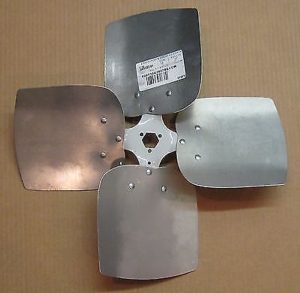
R31818 – FAN BLADE (3, 18″, 33°, CCW, HUBLESS)
Match diameter, blade count, and hub style to your existing blade. Pitch (degrees) is forgiving -- within about 3 degrees is fine (a 27-degree blade works in place of a 25 or 30 degree blade). Rotation depends on your motor: most modern residential condenser fan motors are reversible (look for a jumper or rewireable lead diagram on the motor) -- if yours is reversible, you can use either CW or CCW blade and just wire the motor to match. If your motor is non-reversible, the blade rotation has to match the motor's fixed direction. Diameter is NOT forgiving -- bigger diameter risks hitting the condenser cabinet; smaller diameter creates an air gap that kills capacity. Bring the old blade and your motor's data plate; we'll match at the counter. Tighten the hub set-screws to the FLAT spot on the motor shaft (most condenser shafts have one); never tighten on the round part -- it'll spin loose in days.
10226 Plano Rd, Suite 104, Dallas TX 75238
Questions? Call or text (214) 340-9421
Mon–Fri 10 am – 7 pm | Sat 10 am – 3 pm
Symptoms of failure
- Visible crack, bend or missing chunk on a blade
- Outdoor unit vibrates or wobbles when running
- Blade rubs or ticks against the grille
- Airflow off the top of the condenser is weak
- Blade came loose on the shaft
- Hail or a storm bent the blade
Seeing these does not always mean this part is the culprit. Bring the old one in and we will meter it at the counter, free, before you buy.
Replacement condenser fan blade for HVAC outdoor units. If the original blade is cracked, bent, or missing pieces, replacing it restores proper airflow across the condenser coil — which is critical for cooling performance. Match the diameter, blade count, pitch, and rotation direction to your original blade.
Specs: 18″ diameter, 3 blades, 33° pitch, counterclockwise (CCW), hubless (no hub), aluminum construction
Replaces: N/A
Fits: Most residential and commercial HVAC condenser units requiring a 18-inch CCW blade
Need help? See our AC Fan Not Spinning Guide.
In stock at Open To Public HVAC Parts in Dallas. We test parts at the counter before you buy. Call or text (214) 340-9421.
Specs
- TypeCondenser fan blade
- Blade Count3 blades
- Diameter18"
- Pitch33°
- RotationCCW (counter-clockwise from shaft end)
- Hub StyleHubless (motor shaft direct)
- OEM CompatibilityUniversal
- BoreHubless — universal, fits any hub (hub sold separately)
Installing it yourself
- Kill power at the disconnect and confirm 0V.
- Note the exact blade HEIGHT on the shaft before removal - depth in the shroud sets the airflow.
- Loosen the set screw. The retaining nut is often reverse-threaded.
- Match diameter, blade count, pitch, rotation and bore. Rotation is read from the shaft end - CW and CCW blades are not interchangeable.
- Hubless blades need a hub sized to your motor shaft. Hubbed blades are 1/2" bore.
- Set the new blade to the same height, tighten the set screw onto the flat of the shaft.
- Spin it by hand to check clearance before you restore power.
- A wrong-rotation blade will move air the wrong way and cook the compressor - if you are unsure, bring the old one in.
Power off at the disconnect first, every time. Not sure partway through? Bring it to the counter and we will walk it with you.
Cross-reference numbers
This part replaces the following OEM and aftermarket numbers:
- R31818
Not sure if your number matches? Call (214) 340-9421 or bring the old part in — bench-testing is free.
Fits these models
- Universal aftermarket condenser fan blade — fits residential AC and heat pump condensers with matching diameter / pitch / rotation / hub style
- Common applications: Rheem RA13/RA14/RA16, Goodman GSX13/14/16, Trane XR13/14/16, Carrier / Bryant 13-16 SEER, York / Coleman, Lennox 13-16 SEER
- Verify ALL 5 specs match your existing blade: diameter (16-28"), pitch angle (18-34°), blade count (2/3/4), rotation (CW or CCW), and hub style (hubless vs hub-on-intake)
How do I tell CW vs CCW rotation -- and does it matter for my motor?
Look at the front of the blade. Watch which way it turns when the system is running. CW = clockwise as you face the blade; CCW = counter-clockwise. The arrow stamp on the blade hub also marks rotation. If your motor is reversible (most modern condenser fan motors are), you can use either CW or CCW blade and just wire the motor to match. Non-reversible motors require matching the blade to the motor's fixed direction. Check the motor's data plate or terminal cover for a wiring diagram showing reversible operation.
Can I go up in diameter or pitch?
Pitch is forgiving -- within about 3 degrees is fine. A 27-degree blade will work in place of a 25 or 30 degree blade. Diameter is NOT forgiving -- bigger diameter risks hitting the condenser cabinet; smaller diameter creates an air gap that kills capacity. Match diameter exactly. Going up significantly in pitch (more than 3 degrees) increases CFM and amp draw -- verify your motor's amp rating before installing.
How do I install a fan blade?
1. Slide the blade onto the motor shaft, aligning the hub set-screw with the FLAT spot on the shaft. 2. Position the blade so the leading edge is 1/2"-3/4" inside the venturi (the round opening in the condenser top). 3. Tighten the set-screw on the flat spot. Apply blue thread-locker if available. 4. Spin by hand -- should turn freely with no wobble. 5. Power up briefly to verify rotation direction matches the arrow.
What's a hubless blade?
A hubless blade has the motor shaft pass through a center mounting hole with set-screws directly on the blade hub. A hubbed blade has a separate metal hub that bolts to the blade and holds the set-screws. Hubless = simpler, fewer parts; hubbed = stronger, more common on heavier-duty applications.
Why is my new blade vibrating?
Out-of-balance blade or bent hub. Stop the system immediately -- vibration will destroy the motor bearings. Check for: bent blade tip (impact damage), missing balance clip, loose hub, or wrong blade for the motor. Bring it back; we'll match a balanced replacement.
- Low Stock
 Revcor
R41802 - FAN BLADE (4, 18", 23°, CCW, HUBLESS)
SKU · R41802$92.96View details → - Low StockRevcor
R32007 - FAN BLADE (3, 20", 28°, CW, HUBLESS)
SKU · R32007$92.15View details → - Low StockRevcor
R31601 - FAN BLADE (3, 16", 23°, CW, HUBLESS)
SKU · R31601$89.45View details → - Low Stock
 Lau
Lau4C1827CCW - FAN BLADE (4, 18", 27°, CCW, HUBLESS)
SKU · R41804$92.92View details →