

LA22ZA118 – BLOWER WHEEL (11″ x 10″, CLOCKWISE, CONVEX)
If you're chasing a low-airflow or no-airflow problem, **the blower wheel is almost never the cause.** The real culprits, in order: (1) dirty air filter, (2) dirty evaporator coil, (3) undersized or restricted ductwork, (4) a motor that's not running at full RPM (bad run cap, bad bearings, dying ECM module). Check those first. Blower wheels **fail by flying apart eventually** -- caused by long-term vibration (an out-of-balance wheel, missing balance clips, dirt buildup on one side of the wheel), or by accumulated dirt that finally tears a blade loose. If yours is cracked, has missing balance weights, or the hub has spun loose on the motor shaft, then it's a real replacement. When you replace: match diameter, width, rotation, and blade curve (concave forward-curved vs convex). Bring the old wheel in; we'll match all 4 specs side by side. Tighten the set-screw on the FLAT spot of the motor shaft, never the round part -- it'll spin loose in days.
10226 Plano Rd, Suite 104, Dallas TX 75238
Questions? Call or text (214) 340-9421
Mon–Fri 10 am – 7 pm | Sat 10 am – 3 pm
If your indoor unit runs but produces weak or no airflow, the blower wheel may be worn out. This 11.75×10.75 CW convex wheel is an OEM Carrier/Bryant/Payne part and supersedes the older LA22ZA117 and LA22ZA117A.
Specs: 11.75″ diameter x 10.75″ width, clockwise rotation, convex blade design, steel construction
Replaces: LA22ZA118, LA22ZA117, LA22ZA117A
Fits: Carrier/Bryant/Payne furnaces and air handlers requiring an 11-3/4″ x 10-3/4″ CW blower wheel
In stock at Open To Public HVAC Parts in Dallas. We test parts at the counter before you buy. Call or text (214) 340-9421.
Specs
- TypeDirect-drive blower wheel (squirrel cage)
- Size11" diameter x 10" width
- RotationCW (clockwise from drive end)
- Blade ProfileConvex (backward-curved or specific OEM profile)
- Shaft Diameter1/2" typical (verify with motor)
- OEM CompatibilityUniversal
Cross-reference numbers
This part replaces the following OEM and aftermarket numbers:
- LA22ZA118
Not sure if your number matches? Call (214) 340-9421 or bring the old part in — bench-testing is free.
Fits these models
- Universal aftermarket direct-drive blower wheel (squirrel cage) -- fits residential furnaces and air handlers with matching diameter / width / rotation / blade profile
- Common applications: Rheem RH/RA series, Goodman ARUF/AWUF, Trane TWE/4TEE, Carrier FB4A/FE4A, York TG9/TM9, Lennox CB29/CBA38
- Verify ALL 4 specs match your existing wheel: diameter (9"-12"), width (6"-12"), rotation (CW or CCW from drive end), and blade profile (concave forward-curved vs convex)
My airflow seems weak -- is it the blower wheel?
Almost certainly not. The blower wheel is rarely the cause of low airflow. The real culprits, roughly in order of how often we see them: 1. Dirty filter -- clogged filter = the blower can't pull enough air through it. Replace the filter; many systems recover immediately. 2. Dirty evaporator coil -- caked dust on the indoor coil blocks airflow even with a clean filter. Pull the access cover and inspect; foaming coil cleaner restores most coils. 3. Undersized or restricted ductwork -- too few returns, undersized return drop, kinked flex duct, closed-off supply registers. Static-pressure measurement at the air handler diagnoses this. 4. Motor problems -- bad run cap (most common motor issue), bad bearings, dying ECM module. Check the cap before condemning the motor. 5. Wheel is actually broken -- cracked, missing balance clips, hub spun loose on the shaft. Visible damage on inspection.
How does a blower wheel fail?
Blower wheels typically fly apart over time. The cause is usually long-term vibration from an out-of-balance condition (missing balance clips, dirt buildup on one side of the wheel) or from running with too much accumulated dirt. The blades crack or break free, the hub spins loose, or one side of the wheel separates. Visible damage = real replacement.
How do I tell CW vs CCW rotation?
Look at the drive end of the motor (the end with the shaft sticking out). Watch which way the wheel turns when the blower runs. CW = clockwise as you face the shaft end. CCW = counter-clockwise. Wrong rotation = no airflow / reversed airflow.
What's the difference between concave and convex blades?
Concave (forward-curved) blades scoop air more aggressively -- common on residential furnace blowers, higher CFM at lower RPM. Convex (backward-curved or specific OEM profile) blades are more efficient at higher static pressures -- common on package units and some commercial applications. Match what your unit was designed for.
Why is my new wheel vibrating?
Out-of-balance wheel or bent hub. Stop the blower immediately -- vibration destroys motor bearings fast. Check for: bent blade tips (impact damage during install), missing or moved balance clips (small metal weights on individual blades), loose hub set-screw, or hub mounted on the round part of the shaft instead of the flat. Bring it back; we'll exchange.
How do I install a blower wheel correctly?
1. Slide the wheel onto the motor shaft, set-screw flat aligned with the FLAT spot on the shaft. 2. Position the wheel so its inlet edge is centered on the blower housing inlet ring. 3. Apply blue thread-locker, torque the set-screw to spec. 4. Spin by hand -- should turn freely with NO wobble or rub against the housing. 5. Power up briefly to verify rotation matches the arrow stamped on the hub.
- Low Stock
 Universal
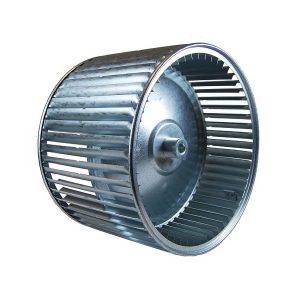
D6723311S - BLOWER WHEEL (11x10, CW, CONVEX)
SKU · D6723311S$137.22View details → - Low Stock
 Universal
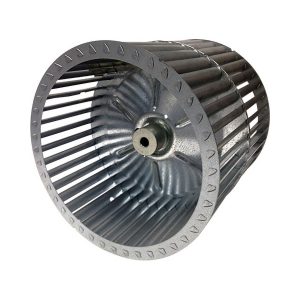
013323-01 - BLOWER WHEEL (10" x 9", CW, CONVEX)
SKU · 013323-01$158.01View details → - Low Stock
 Universal
RBW10206 - BLOWER WHEEL (10" x 7", CCW, CONVEX)
SKU · RBW10206$115.35View details → - In Stock
 Universal
BW45015 - BLOWER WHEEL (10" x 10", CW, CONVEX)
SKU · BW45015$113.38View details →


